
NFC Solution
NFC Business Card Programs
Enterprise Rollout

Quick answer
Procurement-grade enterprise NFC business card programme guide for 100+ employee rollouts. Complements /solutions/nfc-business-card/ (solo and small-team buyer's guide) with the multi-cohort enterprise architecture — HR onboarding flows via SCIM provisioning to NFC card URL routing, marketing-campaign URL rotation without re-issuing cards, Salesforce / HubSpot / Pipedrive lead-capture integration, brand-standard governance across regions and divisions, and the SaaS-platform-extinction risk that the January 2025 Linq sunset crystallised for procurement teams. Covers the four-cohort rollout architecture (executive / sales / customer-success / general workforce), URL routing patterns (per-user GS1 Digital Link, stable redirect URLs on company domain, no-SaaS-lock-in), GDPR Article 28 controller / processor framework for lead-capture data residency, and the offboarding workflow that revokes departing-employee URLs without reprinting cards.
- Plan the routing layer before the cards. A stable redirect URL on the company domain (`https://yourcompany.com/contact/{employee-slug}`) survives platform-extinction, employee turnover, campaign rotation and brand-refresh without reprinting cards. SaaS platforms (Linq, Popl, V1CE, Mobilo, Wave, Blinq) lock the URL to their domain — Linq's January 2025 sunset crystallised the risk.
- SCIM provisioning to NFC card URLs is the enterprise standard. HR system (Workday, BambooHR, Successfactors) → SCIM provisioning to identity provider (Okta, Azure AD) → URL routing rule on company domain. New hire: card pre-encoded with `{employee-slug}`; URL routes to active contact card. Offboarding: SCIM de-provisioning automatically revokes the URL (302 to generic company contact page).
- Four-cohort rollout pattern: executive (metal card + NTAG 424 DNA SUN; vCard + Apple Wallet pass), sales (premium PVC + NTAG215 / 216 + CRM lead-capture integration), customer-success (standard PVC + NTAG213 + appointment-booking URL), general workforce (recycled PVC + NTAG213 + company directory entry).
- CRM lead-capture integration: tap → company-domain landing page → vCard download + lead-form auto-populate → Salesforce / HubSpot / Pipedrive API call to create lead record. Per-tap analytics on the company-side domain provide attribution without third-party SaaS subscription.
- GDPR Article 28 framework: company is data controller for lead-capture data; any SaaS routing platform is processor and needs a Data Processing Agreement. Self-hosted URL on company domain eliminates the processor relationship; PII stays inside existing GDPR / CCPA compliance perimeter.
Featured Business Card Programs Products
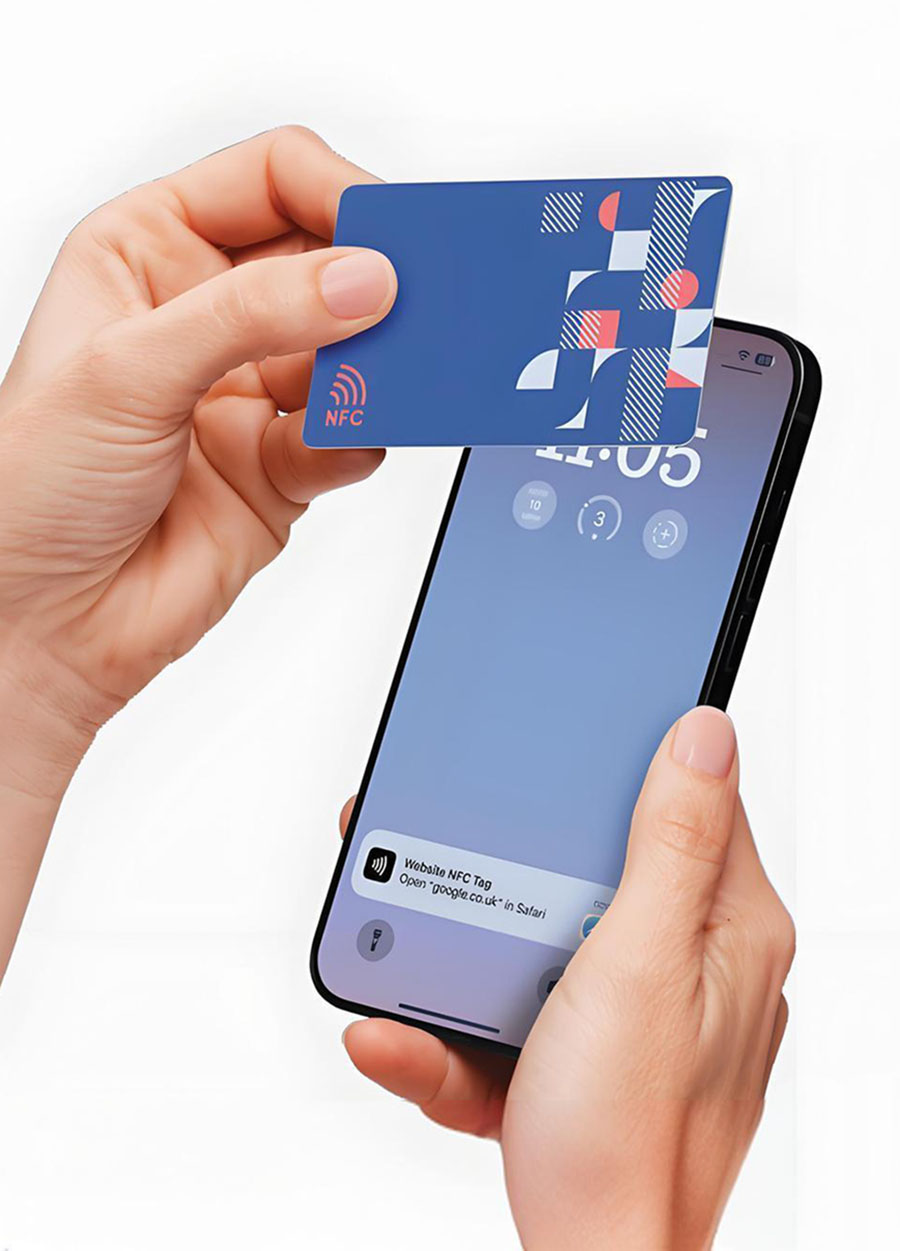
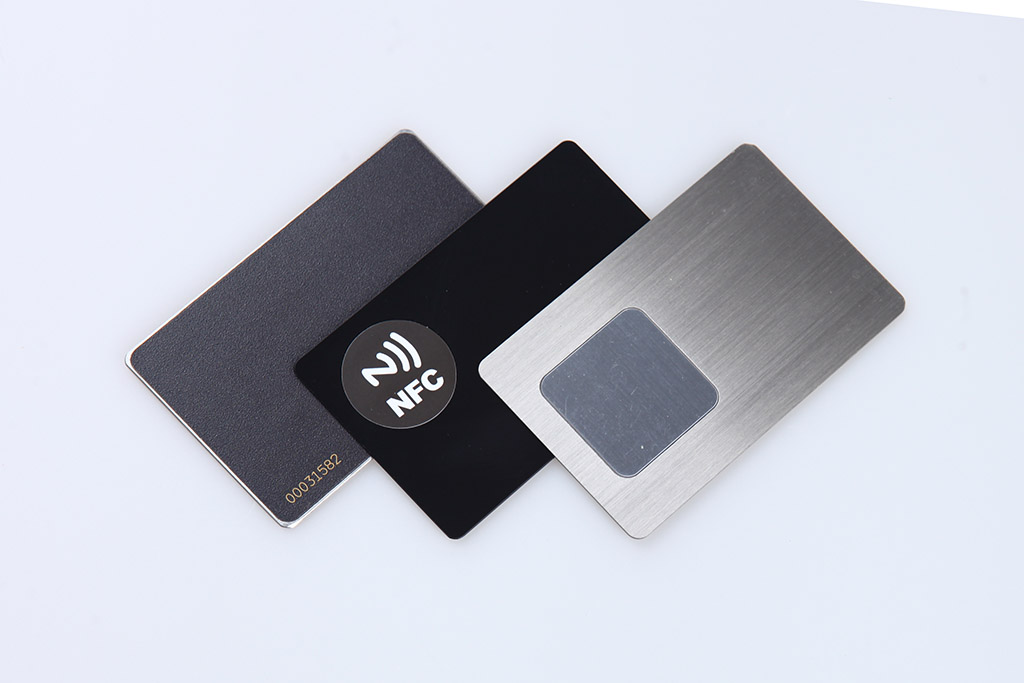
SKUs we typically deploy for business card programs. Tap a card for specs and samples.

At a glance
Use these short answers to decide whether this page matches the project before moving into the detail.
Audience
Enterprise IT + HR teams running 100+ employee NFC card rollouts. Marketing operations + brand standards teams designing multi-cohort programmes.
Decision sequence
Cohort segmentation: executive / sales / customer-success / general workforce. Define material + chip tier per cohort. URL routing layer: stable redirect URL on company...
Next step
Ready to move forward? Start your inquiry to get specific answers for this project.
Get an enterprise NFC programme planEnterprise NFC card programmes — what changed after the Linq sunset (January 2025)
There is a specific flavour of dread reserved for the IT manager who learns the company's business cards now point at a startup's tombstone. Procurement teams running 100+ employee NFC card programmes face a different risk profile than solo or small-team buyers. The dominant risk in 2026 is platform-extinction — the January 2025 Linq sunset (Linq exited the digital-card business and pivoted to AI messaging APIs) left enterprise customers with a deteriorating routing layer that they couldn't fix without re-issuing cards across their entire workforce.
**Why enterprise is more exposed than solo.** A solo NFC card user whose SaaS platform sunsets reorders one card from a different vendor in 10 minutes. An enterprise with 500 sales reps has to: (1) procure replacement cards from a new vendor (typically 3-4 week lead time including artwork + pre-encoding), (2) coordinate distribution to 500 employees across global offices, (3) update CRM lead-capture integration to the new vendor's API, (4) communicate the change to existing prospects who have the old card already saved. Total cost in time + lost lead capture during transition is typically 5-10× the original card programme cost.
**The fix is in the URL routing layer, not the chip.** An enterprise programme where each card encodes `https://yourcompany.com/contact/{employee-slug}` is platform-extinction-immune — the URL routes server-side via the company's own web server. If a SaaS engagement layer is in use, the company can swap providers without touching the cards. If no SaaS is needed, the cards work indefinitely.
**SCIM provisioning closes the loop.** HR system → SCIM → IdP (Okta, Azure AD) → URL routing rule. New hire on Day 1: card encoded with `{employee-slug}` works immediately because the routing rule was created when SCIM provisioned the user. Offboarding: SCIM de-provisioning removes the routing rule; URL returns 410 Gone or redirects to a generic company contact page. No physical card recovery needed.
**The procurement consequence:** OEM-direct cards pointing at the company's own domain + SCIM-automated URL provisioning is the 2026 enterprise standard. SaaS routing platforms remain valid for solo + small-team programmes (where the lock-in cost is small); for 100+ employee rollouts the OEM-direct + self-hosted-URL pattern is the safer architecture.
Four-cohort rollout architecture — executive, sales, customer-success, general workforce
Every enterprise card programme eventually rediscovers the same quiet law of organisational physics: card weight tends to track job title, and nobody has to be told why. Enterprise NFC card programmes typically segment the workforce into four cohorts with different card materials, chip families, and engagement workflows. The matrix below is the cost-effective default; specific industries adjust (e.g., legal firms might run only executive + general cohorts; sales-led tech companies might expand the sales cohort and skip customer-success).
- **Material tier signals seniority** — executive metal cards carry brand and personal positioning; sales premium PVC + wood cards carry brand-personal balance; customer-success and general workforce cards carry primarily functional value.
- **Chip tier follows engagement complexity** — NTAG 213 (144B) for URL-only redirect; NTAG 215/216 for embedded vCard payload; NTAG 424 DNA SUN for executive anti-clone authentication.
- **MOQ at enterprise scale** — typical 100-employee rollout buys 500–1,000 cards (2× quantity buffer for replacements, lost cards, marketing campaign rotation). At MOQ 1,000+ supplier negotiation tier cost drops 30-50% vs MOQ 100.
- **Brand standards** — each cohort gets a distinct artwork variation (metal + brand mark for executive; full-colour CMYK with employee name for sales; cleaner / lighter brand for customer-success; standard for general). Centralised brand-standards review approves each cohort's artwork once; per-employee customisation happens via the URL routing layer, not the printed card.
- **Re-issuance cadence** — typical re-order annually: 10–20% of cards (replacements, lost / damaged, new hires, role changes). Plan re-order into the recurring marketing budget.
| Cohort | Material + chip | Cost / card | Engagement layer |
|---|---|---|---|
| Executive (C-suite, VP, board) | Metal + ferrite + NTAG 424 DNA SUN | $25–$55 | vCard + Apple Wallet pass + scheduled-meeting booking link |
| Sales (account executives, BD, partners) | Premium PVC or FSC wood + NTAG 215/216 | $3–$10 | CRM lead-capture integration (Salesforce / HubSpot); event-campaign URL rotation |
| Customer-success (CSM, support, onboarding) | Standard PVC + NTAG 213 | $1.50–$3 | Appointment-booking URL + support ticket creation |
| General workforce (engineering, ops, etc.) | Recycled PVC (GRS) + NTAG 213 | $2–$4 | Company directory entry + LinkedIn URL |
URL routing — stable redirect URL on company domain, SCIM-provisioned
The architectural decision that determines enterprise programme success: where does the URL on the card point to. Three patterns exist; the recommended pattern for 100+ employee rollouts is the stable-redirect-on-company-domain pattern.
- **Pattern 1 — Static URL on company domain (recommended).** Each card encoded with `https://yourcompany.com/contact/{employee-slug}` at the converter. URL never changes after card production. Server-side redirect rule maps `{employee-slug}` → current contact page / vCard / lead-capture form. Survives any vendor pivot, marketing-campaign rotation, brand refresh, employee role change.
- **Pattern 2 — SaaS routing platform.** Each card encoded with `https://linq.app/{employee-id}` (or Popl, V1CE, Mobilo, Wave, Blinq). Convenient turnkey but lock-in risk realised at Linq's January 2025 sunset. SaaS pricing $6.99–15.99 / user / month for full features = $17K–38K / year at 200-employee scale in perpetuity.
- **Pattern 3 — Hybrid.** Card encoded with company-domain URL; redirect routes through self-hosted analytics endpoint (Plausible, Matomo) before resolving to the SaaS engagement layer. Captures analytics on company side; keeps SaaS turnkey for non-mission-critical engagement features.
- **SCIM provisioning** — System for Cross-Domain Identity Management (SCIM 2.0; RFC 7643 + 7644) is the open standard for automated user provisioning. Pattern: HR system (Workday, BambooHR, ADP, Successfactors) writes user creation/update/deletion events to IdP (Okta, Azure AD) via SCIM API. IdP writes URL routing rule on company web server.
- **New-hire workflow** — Day 0: HR creates user in Workday. SCIM triggers Okta provisioning. URL routing rule created (`{slug}` → `{employee-id}` → contact page). NFC card already encoded with `{slug}` works on Day 1.
- **Offboarding workflow** — HR deactivates user in Workday. SCIM triggers Okta de-provisioning. URL routing rule removed; `https://yourcompany.com/contact/{slug}` returns 410 Gone or redirects to generic company contact page. No physical card recovery needed; the card simply stops resolving.
CRM lead-capture integration — Salesforce, HubSpot, Pipedrive, Marketo
Enterprise NFC card programmes typically tie into the CRM that owns lead-capture workflows. The tap → lead-form auto-populate → CRM API call is the standard integration pattern.
- **Salesforce** — REST API + Sales Cloud lead creation. Pattern: NFC tap → company landing page with employee-pre-populated lead form → form submit triggers Salesforce REST API call creating Lead record with `Owner = {employee_salesforce_id}`. Per-tap analytics via Salesforce reports.
- **HubSpot** — Smart Forms + Workflows. Pattern: NFC tap → HubSpot-hosted or company-hosted landing page → smart form submit → HubSpot CRM Lead created with `HubSpot Owner = {employee_hubspot_id}` and automatic workflow trigger.
- **Pipedrive** — REST API + activity automation. Pattern: NFC tap → company landing page → form submit → Pipedrive REST API creates Deal in pipeline assigned to `{employee_pipedrive_user_id}`.
- **Marketo** — landing page + program enrollment. Pattern: NFC tap → Marketo-hosted landing page → form submit → Marketo Lead + Program enrollment.
- **Microsoft Dynamics 365 Sales** — analogous REST API integration; common in Microsoft-shop enterprises.
- **Multi-region routing** — international sales teams need region-specific routing (US sales → North America Salesforce instance; EU sales → EMEA Salesforce instance with EU data residency). The company-domain URL routing layer handles the regional split server-side; cards don't need to be region-specific.
- **Lead-capture form fields** — minimal fields convert better. Typical: name, email, company, phone (optional). Per-tap source attribution (event ID, campaign ID, employee ID) automatically populated server-side without prompting the user.
Marketing-campaign URL rotation — same cards, different destinations
Enterprise programmes typically rotate NFC card destinations multiple times per year for event campaigns, product launches, partner programmes. The stable-redirect pattern lets cards rotate without physical re-issuance.
- **Conference / event mode** — during Dreamforce, HIMSS, NRF, RSAC the sales team's NFC card redirects to a conference-specific landing page (`/event/dreamforce-2026/{employee-slug}`). After the event, redirect rolls back to the standard contact page. Same physical card; different landing.
- **Product launch campaign** — during a new product launch, the entire sales team's cards redirect to a product-specific landing page with embedded demo request. Run for 4–8 weeks; revert to standard.
- **Partner / co-marketing campaign** — joint go-to-market with a partner (e.g., AWS, Microsoft) routes cards to a co-branded landing page during the partnership window.
- **A/B testing** — different cohorts route to different landing variants; conversion data informs the standard landing page redesign.
- **Server-side analytics** — every redirect captures campaign ID, employee ID, tap timestamp, device class, downstream click-through. Per-employee performance metrics for sales-operations dashboards.
- **Brand-refresh transition** — during brand-refresh windows (typically every 3–5 years), redirects can roll out new brand artwork on the landing page while old-brand cards continue to function. Eliminates urgency to re-issue cards during brand transitions.
GDPR / CCPA / SOC 2 — data residency and DPA framework
Enterprise lead-capture flows cross GDPR Article 28 controller/processor lines, CCPA processor-disclosure obligations, and SOC 2 audit scope. The architectural choice (self-hosted URL vs SaaS routing) determines which obligations apply.
- **GDPR Article 28** — company is data controller for lead data captured via NFC card. Any SaaS routing platform is processor; needs a Data Processing Agreement, sub-processor list audit, data residency commitment. Self-hosted URL eliminates the processor relationship entirely.
- **CCPA controller/processor framework** — similar shape for California-resident lead data. Self-hosted URL eliminates CCPA processor-disclosure obligations.
- **SOC 2 audit scope** — if NFC card programme touches lead-capture systems in SOC 2 scope, the routing layer falls inside scope. Self-hosted URL on company domain keeps the routing layer inside existing SOC 2 boundary; SaaS routing adds a vendor in the audit-trail.
- **Data residency** — EU sales teams' lead data typically needs to land in EU-region Salesforce / HubSpot / first-party DB. Company-domain URL routing layer enforces region routing server-side (`/contact-eu/{slug}` for EU staff).
- **Cookie / consent** — landing page that captures lead data typically requires GDPR cookie consent. Standard integrations with OneTrust, TrustArc, Cookiebot apply.
- **Right-to-erasure** — GDPR Article 17 right to be forgotten applies to lead data captured via NFC card. CRM + landing-page database must support DSAR (Data Subject Access Request) and erasure workflows.
- **Offboarding evidence** — for compliance audit, document that departing employee's card URL was revoked within X business days of offboarding (typical 1-3 days). Server-log evidence ties offboarding event to URL routing rule removal.
Aliro 1.0 + mobile wallet integration
Aliro 1.0 (CSA released February 2026) introduces unified digital-key + business-card standards across Apple, Google and Samsung wallets. Enterprise NFC card programmes can pair physical cards with mobile-wallet digital business cards as an overlay.
- **Apple Wallet contact pass** — executive + sales cohorts often pair physical card with Apple Wallet contact pass. The wallet pass is provisioned via the company's MDM (Jamf, Intune, Kandji) or sent via email link.
- **Google Wallet contact pass** — analogous for Android. Provisioned similarly via MDM.
- **Samsung Wallet** — Samsung-specific pass integration; relevant in markets with high Samsung share (Korea, parts of Asia).
- **Aliro 1.0 unification** — Aliro published February 2026 by CSA unifies the implementation pattern across the three wallet platforms. Enterprise programmes planning 2026–2028 rollouts should specify Aliro-readiness in vendor selection.
- **Hybrid pattern** — physical card stays the brand-presentation moment (tactile, gift-able, memorable); wallet pass provides backup + always-on contact-share for tap-to-share between phones (without needing the physical card).
- **ProTip** — the wallet pass URL can be the same `https://yourcompany.com/contact/{slug}` URL as the physical card. Server-side routing detects the User-Agent and serves different responses (vCard for direct browser; wallet pass installer for wallet-specific access).
Pricing and MOQ at enterprise scale
The figures below are the unglamorous part of the programme — and also the part that decides whether your contact-sharing strategy outlives the vendor that sold it to you. Enterprise programmes typically aggregate cross-cohort volume to hit better per-card pricing. The table below assumes a 200-employee programme with four cohorts.
- **Programme TCO over 3 years** — typical $15K–$50K for the 200-employee programme above; vs $50K–$120K for SaaS routing alternative ($15K–$40K / year × 3). Self-hosted ROI within 1 year.
- **Sample lead time** — 5–10 working days for paper / PVC sample cards; 10–15 working days for metal / hardwood samples; 15–20 working days for NTAG 424 DNA SUN samples (requires AES key provisioning).
- **Production lead time** — 3–4 weeks for PVC at MOQ 500; 4–5 weeks for metal / hardwood; 5–6 weeks for NTAG 424 DNA SUN at MOQ 200.
- **Re-issue cadence** — plan annual 10–20% re-issue for new hires, lost cards, role changes. Reduce friction with always-stock-on-hand of standard cohort cards.
| Cohort | Quantity (200-employee programme) | Cost / card | Cohort total |
|---|---|---|---|
| Executive (10–20 people) | 30–50 cards (incl. spares) | $25–$55 | $1,000–$2,500 |
| Sales (50–80 people) | 100–200 cards | $3–$10 | $500–$2,000 |
| Customer-success (30–50 people) | 60–120 cards | $1.50–$3 | $200–$400 |
| General workforce (80–120 people) | 150–300 cards | $2–$4 | $400–$1,200 |
| Total programme | 340–670 cards | — | $2,100–$6,100 |
| Add Apple Wallet / Google Wallet pass infrastructure (one-time) | — | — | $2K–$10K setup |
| Add SCIM provisioning integration (engineering) | — | — | $5K–$30K |
| Add CRM lead-capture integration (engineering) | — | — | $10K–$50K |
| Add company-domain URL routing infrastructure | — | — | $1K–$5K / year hosting |
| Ongoing annual replacement / re-order | — | — | 10-20% of programme cost |
Useful next pages
Use these linked product, guide and comparison pages to keep the next click specific and practical.
NFC card products
Material + chip combinations for enterprise rollouts.
Related solutions
Solo / small-team sibling + adjacent NFC programmes.
Side-by-side comparisons
Material + chip selection deep-dives.
Related editorial
Background reading.
FAQ
Why did Linq sunset and what does it mean for our 200-employee NFC card programme?
Linq exited the digital business-card business in January 2025 and pivoted to AI messaging APIs. Customers whose cards pointed at Linq-controlled URLs lost the routing layer; replacement required re-issuing physical cards across the entire workforce. The procurement lesson for enterprise programmes: every SaaS routing platform is one strategic pivot from orphaning your card inventory. Mitigation: encode cards with `https://yourcompany.com/contact/{slug}` (your own domain) and route server-side. If Linq, Popl or any SaaS partner pivots, you swap routing logic without touching cards.
How does SCIM provisioning to NFC card URLs work in practice?
Three-tier flow: (1) HR system (Workday, BambooHR, ADP) creates employee record. (2) SCIM (System for Cross-Domain Identity Management, RFC 7643 + 7644) provisions the employee to your identity provider (Okta, Azure AD) with attributes like email, role, region. (3) IdP triggers a URL routing rule creation on your web server (e.g., maps `{employee-slug}` → `{employee-id}` → contact page). NFC cards are pre-printed with `{slug}` patterns; first day on the job the card already works. Offboarding: SCIM de-provisioning removes the routing rule; URL returns 410 Gone.
Should we use SaaS routing (Linq, Popl, V1CE) or self-host the URL?
For 100+ employee programmes, self-host on the company domain. SaaS routing pricing ($6.99–$15.99 per user per month for full features) at 200-employee scale runs $17K–$38K / year in perpetuity — and carries platform-extinction risk per the Linq sunset. Self-hosted routing infrastructure costs $1K–$5K / year hosting + one-time $5K–$30K engineering integration. Payback within 1 year vs SaaS. SaaS still makes sense for solo or sub-10-person programmes where the lock-in cost is small and time-to-market matters more than long-term TCO.
How do we integrate with Salesforce / HubSpot for lead capture?
Standard REST API integration pattern. Customer taps NFC card → lands on company-domain landing page with employee-pre-populated lead form → form submit triggers REST API call to Salesforce (Lead create) / HubSpot (Lead create + workflow) / Pipedrive (Deal create) / Marketo (Lead + Program). Server-side automatic attribution: campaign ID, employee ID, tap timestamp, device class. Per-employee performance metrics for sales-operations dashboards. Engineering cost typically $10K–$50K for the full integration build.
How do we offboard a departing employee's NFC card without recovering the physical card?
Routing-layer revocation. SCIM de-provisioning from HR system → IdP removes URL routing rule on company domain → URL returns 410 Gone or redirects to generic company contact page. The physical card continues to exist but no longer resolves to a working contact. Some companies route departing employees to a 'team contact' page instead of 410 (`{slug}` → `https://yourcompany.com/contact/team-sales/`). Document the revocation workflow in offboarding policy + retain server logs as compliance evidence.
Can we run campaign URL rotation without re-issuing cards?
Yes — that's the core operational advantage of stable-redirect-on-company-domain. During a Dreamforce / HIMSS / partner-launch campaign, redirect rule changes serve a campaign-specific landing page (`/event/{event-id}/{employee-slug}`). After the campaign, redirect rolls back to the standard contact page. Same physical card; different landing. A/B testing different landing variants is similarly trivial at the redirect-rule layer. Brand-refresh transitions handled the same way — new landing artwork, old physical cards continue to function.
What's the GDPR / DPA requirement when SaaS routing is in scope?
Company is data controller for lead data captured via NFC card; SaaS routing platform is processor. GDPR Article 28 requires DPA (Data Processing Agreement), sub-processor list audit, data-residency commitment, and standard contractual clauses for international data transfer. Self-hosted URL on company domain eliminates the processor relationship entirely — PII stays inside the existing GDPR / CCPA compliance perimeter. For enterprise programmes operating under SOC 2 audit, this also matters: self-hosted routing keeps the routing layer inside existing SOC 2 boundary instead of adding a vendor in the audit trail.
Should executives get NTAG 424 DNA SUN cards?
Worth it. NTAG 424 DNA SUN provides AES-128 CMAC per-tap unique URL signing; server-side validation detects clones in real time. For C-suite + board cards (high-value relationships, anti-impersonation concerns) the $20–30 cost premium per chip vs NTAG 213 pays back on the trust signal alone. Pair NTAG 424 DNA SUN chip with metal card body + Apple Wallet pass for the premium executive cohort. For sales / customer-success / general workforce, NTAG 213 / 215 is sufficient — anti-clone concerns are typically not material for these cohorts.
Sources & references
Primary standards, OEM datasheets and regulatory documents cited by this article. All URLs were verified on the access date shown below.
- NXP NTAG213 / 215 / 216 datasheet
Chip-family reference.
- NXP NTAG 424 DNA datasheet (NT4H2421Gx)
Executive-cohort chip with AES-128 SUN authentication.
- IETF RFC 7643 — System for Cross-Domain Identity Management (SCIM): Core Schema
SCIM 2.0 core schema for HR-to-IdP provisioning.
- IETF RFC 7644 — SCIM Protocol
SCIM 2.0 protocol specification.
- Okta SCIM provisioning documentation
Reference SCIM-to-IdP integration pattern.
- Azure AD SCIM provisioning
Microsoft IdP SCIM integration pattern.
- Salesforce REST API Lead create
Reference API for CRM lead-capture integration.
- HubSpot Smart Forms + Workflows
HubSpot CRM integration pattern.
- Pipedrive REST API
Pipedrive Deal + Activity API reference.
- Marketo Landing Page + Forms documentation
Marketo integration pattern.
- Apple Developer — Wallet Passes
Apple Wallet contact-pass provisioning reference.
- Google Wallet API documentation
Google Wallet pass provisioning reference.
- Aliro 1.0 specification release (CSA, February 2026)
Unified digital-key / business-card standard across Apple / Google / Samsung wallets.
- IETF RFC 6350 — vCard 4.0 specification
vCard 4.0 with multi-language LANG parameter + UTF-8 encoding.
- GDPR Article 28 (EUR-Lex)
Controller / processor framework for SaaS-routing DPA negotiation.
- California CCPA / CPRA Cal. Civ. Code §1798.100 et seq.
California consumer privacy framework for lead-capture data.
- AICPA SOC 2 reference
SOC 2 audit framework for enterprise routing-layer scope.
- Apple Developer — Adding Support for Background Tag Reading
iPhone XS+ background tag reading reference.
- FSC chain-of-custody (FSC-STD-40-004)
Wood + bamboo card sustainability certification.
- Global Recycled Standard (GRS)
Recycled PVC ≥50% post-consumer recycled content claim.
Proud Tek is a Shenzhen-based RFID & NFC manufacturer supplying hotel chains, transit operators, event venues and retail brands worldwide. Every order includes free samples, RF testing and dedicated project support.
Get a Quick Quote
Tell us about your project and we'll respond within one business day. Fields marked (asterisk) are required.