
Access Control Solution
RFID Keyfobs for Access Control (2026)
HID iCLASS Seos / MIFARE DESFire EV3 / SALTO Neo / Schlage / Aliro 1.0 Compatibility, Commercial Office + Multi-Tenant + Gym Procurement Guide

Quick answer
Procurement-grade RFID keyfob guide for commercial offices, multi-tenant residential, gym + fitness studio, university campus, healthcare staff zones, and any access-control programme where keyfob form-factor wins over card form-factor (durability on a keyring, single-hand presentation, anti-loss on a lanyard or pocket-clip). Maps the chip family decision (HID iCLASS Seos for HID-stack commercial buildings; MIFARE DESFire EV3 for SALTO / dormakaba estates; HID Prox 125 kHz / EM4100 for legacy buildings; NXP UCODE for UHF long-range parking + vehicle access), the standards anchor (HID Seos credential format, ISO/IEC 14443 Type A air interface, OSDP v2 Secure Channel reader-to-controller), the Aliro 1.0 unified digital-credential standard (CSA February 2026) for mobile-keyfob convergence, and the 2026 procurement framing (which buildings still run Wiegand vs OSDP Secure Channel; iCLASS Classic 13.56 MHz vs iCLASS Seos AES-128 migration; physical-keyfob baseline alongside Apple Wallet mobile credentials).
- Pick the chip by access-control stack. HID iCLASS Seos for HID-stack commercial buildings (offices, multi-tenant, healthcare); MIFARE DESFire EV3 for SALTO / dormakaba / non-HID estates; HID Prox 125 kHz / EM4100 for legacy buildings where reader upgrade isn't in scope.
- Keyfob form-factor advantage: durability on a keyring, single-hand presentation, anti-loss. Card form-factor stays appropriate for visitors / temporary access; keyfob is the right form for staff / tenant / member who carries it daily.
- OSDP v2 Secure Channel is the 2026 reader-to-controller standard. Replacing 1970s Wiegand plain-text protocol with AES-128 mutual authentication closes the wire-side attack surface that even a remediated lock + DESFire EV3 chip leaves open. Plan reader migration alongside any keyfob refresh.
- Aliro 1.0 (Connectivity Standards Alliance, February 2026 release) unifies the implementation of digital keys + credentials across Apple Wallet, Google Wallet and Samsung Wallet. Most enterprise access programmes plan 2026 vendor selection for mobile-credential pilot; physical keyfob baseline remains for ADA / device-failure / visitor scenarios.
- Cross-vendor compatibility: HID Origo, ASSA ABLOY Mobile Access, SALTO JustIN Mobile, dormakaba Mobile Access Solutions, Schlage Engage. The keyfob procurement decision intersects with the mobile-credential roadmap; plan together.
Featured Keyfob Access Products
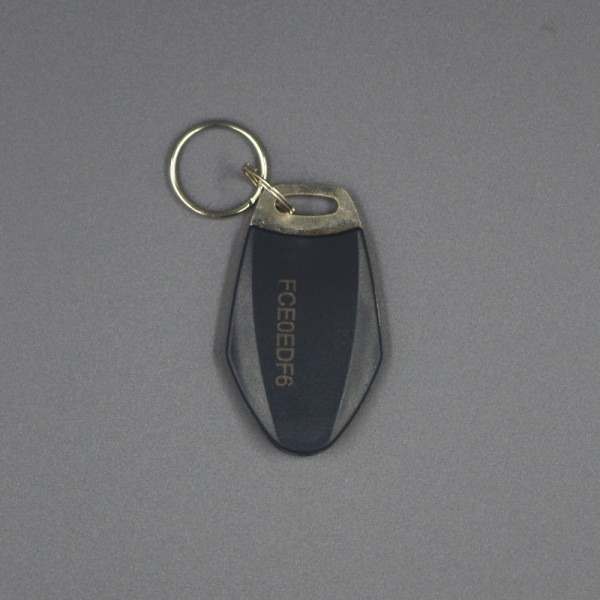
SKUs we typically deploy for keyfob access. Tap a card for specs and samples.
At a glance
Use these short answers to decide whether this page matches the project before moving into the detail.
Audience
Commercial office property managers running staff + tenant + visitor access programmes. Multi-tenant residential property managers (condos, apartments, mixed-use) issuin...
Decision sequence
Existing access-control stack: HID iCLASS / Seos vs SALTO XS4 vs dormakaba EVERYTHING vs Schlage / Allegion ENGAGE vs LenelS2 OnGuard vs Software House CCURE. Chip famil...
Next step
Ready to move forward? Start your inquiry to get specific answers for this project.
Discuss keyfob optionsKeyfob vs card vs wristband — when keyfob wins
The form-factor choice (keyfob, card, wristband, mobile credential) follows the user's daily-carry pattern. Keyfob wins on durability, single-hand presentation and anti-loss for users who carry credentials on a keyring or pocket-clip; card wins on lanyard-carry visibility for badged employees; wristband wins for venue-attended use cases; mobile wins on guest convenience when smartphone is the daily carry.
- **Keyfob daily-carry advantage** — fits on a keyring with house keys, car keys, or carabiner; doesn't bend or break in pocket; single-hand presentation at reader; rarely forgotten because it's with everything else important. Standard for office / tenant / gym / staff zones.
- **Card form-factor wins for** — visitor / temporary access (lanyard-mounted display badge), employee identification (printed photo / name + access in one credential), payment-card-style adjacencies (combined access + cafeteria payment).
- **Wristband form-factor wins for** — event attendance, hospital patient, theme park, gym day-pass, all-inclusive resort. See `/solutions/rfid-event-wristbands/` for that use case.
- **Mobile form-factor wins for** — guest convenience (no physical credential issuance for short-stay scenarios), corporate BYOD (employees who don't want carrying a physical credential), high-tech / digital-native workplaces.
- **Hybrid pattern at scale** — most enterprise access programmes run mobile credential as primary (guest experience) + physical keyfob as backup (ADA, device failure, visitor, override scenarios). The physical baseline is the operational safety net, not the primary user experience.
- **Anti-loss differential** — industry data: keyfobs lose at 3–8% / year per user vs cards at 12–25% / year (cards more often forgotten or damaged). Keyfob's keyring attachment is the structural reason.
Chip family decision — HID Seos, MIFARE DESFire EV3, HID Prox, EM4100, UHF
Chip family follows the existing access-control reader stack at the property. Five families dominate the 2026 procurement decision.
- **HID iCLASS Seos (current HID standard)** — AES-128 + ECDH key exchange; mutual authentication. Default for HID-stack commercial buildings, healthcare, multi-tenant residential. HID's flagship credential since 2014; OSDP v2 Secure Channel native. Cost: $4–10 per keyfob at MOQ 500+.
- **MIFARE DESFire EV3** — NXP's premium NFC family; AES-128 authenticated sessions; ISO/IEC 14443 Type A. Default for SALTO XS4 / dormakaba / non-HID access-control estates. Read-compatible across virtually every current contactless reader. Cost: $3–8 per keyfob.
- **HID iCLASS Classic (13.56 MHz, legacy)** — pre-Seos HID chip; uses HID's proprietary cryptographic stack rather than open AES-128. Many buildings still run iCLASS Classic readers; new deployments should migrate to Seos. Cost: $2–6 per keyfob.
- **HID Prox / EM4100 (125 kHz, legacy)** — low-frequency proximity; chip UID only, no cryptographic authentication. Vulnerable to easy cloning. Many older buildings still run this stack; upgrade to 13.56 MHz Seos / DESFire is the 2026 procurement direction. Cost: $1–3 per keyfob.
- **NXP UCODE (UHF, 860–960 MHz)** — long-range read (1–5m at parking gates, vehicle access). Different reader infrastructure than HF (13.56 MHz). Cost: $1–3 per UHF keyfob (varies by encapsulation).
- **Dual-frequency keyfob (125 kHz + 13.56 MHz)** — bridge format for buildings migrating from Prox to Seos; one keyfob works on both old and new readers during the transition window.
- **Multi-protocol keyfob** — single keyfob with multiple chips for users accessing multi-vendor properties (e.g., apartment building HID Prox + corporate office HID Seos + gym MIFARE).
OSDP v2 Secure Channel — replacing Wiegand on new builds
OSDP v2 Secure Channel is the 2026 reader-to-controller protocol standard. Replacing 1970s Wiegand closes the wire-side attack surface. The keyfob form factor doesn't directly determine OSDP migration, but the access-control refresh cycle is the natural moment to upgrade both.
- **Wiegand vulnerability** — plain-text data on the wire between reader and controller. A tap-on-wire attack captures every credential without ever touching a keyfob. Even DESFire EV3 cryptographic chip is undermined by Wiegand back-end transport.
- **OSDP v2 Secure Channel** — AES-128 mutual authentication between reader and controller. Session-key encrypts subsequent traffic. Tap-on-wire attacks become useless.
- **Security Industry Association (SIA)** — maintains the OSDP standard. Published 'There Is a Hole in the Boat' (November 2021) advocating Wiegand → OSDP migration.
- **Dual-protocol readers** — common transition pattern: install readers supporting both Wiegand (legacy controller compatibility) and OSDP (forward-compatible). Migrate controllers over multi-year cadence.
- **Keyfob compatibility** — OSDP migration happens at reader-to-controller layer; doesn't affect the keyfob chip choice. DESFire EV3 / Seos keyfobs work identically across Wiegand and OSDP back-ends.
- **Procurement timing** — combining keyfob refresh with OSDP migration is operationally efficient: schedule single building shutdown for reader + keyfob replacement rather than two separate cycles.
Aliro 1.0 + mobile credential coexistence
Aliro 1.0 (Connectivity Standards Alliance, February 2026 release) unifies digital credentials across Apple Wallet, Google Wallet and Samsung Wallet. Most enterprise access programmes run physical keyfob as the operational baseline alongside mobile-credential pilot.
- **Aliro 1.0 standard** — CSA published February 2026 to unify mobile-credential implementation across the three wallet platforms. Eliminates vendor-specific BLE app sprawl for digital keys.
- **HID Origo** — HID's mobile-credential platform; Aliro-readiness roadmap committed.
- **ASSA ABLOY Mobile Access** — ASSA ABLOY's analogous mobile-credential offering; covers SALTO + ASSA ABLOY commercial properties.
- **SALTO JustIN Mobile** — SALTO's first-party BLE mobile-credential app; works with XS4 readers.
- **dormakaba Mobile Access Solutions** — dormakaba's mobile-credential platform via LEGIC Connect backbone.
- **Schlage Engage** — Allegion's mobile credential platform for Schlage locks.
- **Physical baseline remains operational requirement** — ADA / device-failure / visitor / override / shared-credential scenarios still need a physical keyfob. Most enterprise programmes specify 'mobile credential as primary, keyfob as backup for all employees + primary for visitors'.
- **Aliro-readiness as RFP criterion** — for 2026–2028 access-control vendor selection, specify Aliro 1.0 roadmap as RFP requirement. Vendors not roadmapped to Aliro represent retrofit risk.
Form factor options — round, oval, square, key-shaped, leather, metal, LED
Keyfob form factors vary by aesthetic + functional fit. The matrix below maps the common form factors to use cases and cost.
- **Default for office + multi-tenant** — round or oval ABS keyfob with HID Seos or MIFARE DESFire EV3 chip. $1–3 per keyfob at MOQ 500+.
- **Premium executive** — leather wrap or metal keyfob for C-suite / board / VIP residential tenant. $5–25.
- **Gym member acquisition** — branded keyfobs are a low-cost member-onboarding gift. ABS with embossed gym logo. $1–2 per keyfob at MOQ 5,000+.
- **LED variants** — useful for users frequently finding fob in dark settings (parking garage at night, gym locker). LED battery typically 3-5 year service life.
- **Metal keyfob considerations** — ferrite isolator required behind the chip antenna; read distance roughly halved vs ABS plastic body.
| Form factor | Material | Use case | Indicative cost |
|---|---|---|---|
| Round keyfob (classic) | ABS / PC plastic | Office / multi-tenant / gym standard | $0.80–3.00 |
| Oval keyfob (slimmer) | ABS / PC plastic | Slimmer keyring fit | $0.80–3.00 |
| Square keyfob | ABS / PC plastic | Sponsor branding (more surface area) | $1.00–3.50 |
| Key-shaped keyfob | ABS shaped like a key | Visual aesthetic / mistaken-for-a-key acceptable | $1.50–4.00 |
| Leather wrap keyfob | Genuine / vegan leather | Premium executive / luxury residential | $5–25 |
| Metal keyfob | Brushed aluminum + ferrite isolator | Luxury executive / corporate gift | $8–30 |
| LED-equipped keyfob | ABS + LED | Easy locate in dark / gym lockers | $3–8 |
| Wristband-keyfob hybrid | Silicone + chip | Gym / sports / event venue | $2–6 |
| Carabiner keyfob | ABS + metal clip | Hiking / outdoor / industrial workwear | $2–6 |
| NFC + UHF dual keyfob | ABS + dual antenna | Parking gate (UHF) + door access (NFC HF) on one fob | $3–10 |
Vendor stack compatibility — HID, ASSA ABLOY, SALTO, dormakaba, Allegion, LenelS2
Keyfob compatibility follows the access-control stack at the property. Major commercial access-control vendors each have preferred chip families + reader stacks.
- **HID Global** — flagship HID iCLASS Seos credential + HID readers + HID Mercury / OPIN-compatible controllers. HID's stack dominates commercial offices, healthcare, multi-tenant residential, university campus.
- **ASSA ABLOY Global Solutions (Aperio + SARGENT + Yale)** — supports HID iCLASS Seos + MIFARE DESFire EV3 via multi-protocol readers. Wide deployment in hotels (Vingcard), commercial offices, residential.
- **SALTO Systems** — preferred MIFARE DESFire EV3 + SALTO Neo cylinder + JustIN Mobile. Strong in boutique + independent commercial + European multi-tenant.
- **dormakaba (formerly Kaba + Dorma merger)** — supports MIFARE family + LEGIC; LEGIC stack common in European DACH-region commercial. dormakaba's Saflok brand for hospitality (separate from commercial offering).
- **Allegion (Schlage / Von Duprin / LCN)** — Schlage Engage mobile + iCLASS Seos via multi-tech readers. Strong in commercial office, K-12 + higher education, healthcare.
- **LenelS2 OnGuard** — access-control management platform; reader-agnostic via Mercury / OPIN-compatible controllers. Pairs with HID Seos or DESFire keyfobs depending on building.
- **Software House (Tyco / Johnson Controls) CCURE 9000** — analogous to LenelS2 OnGuard; reader-agnostic.
- **Genetec Security Center** — newer entrant; cloud-native option; pairs with HID Origo for mobile + iCLASS Seos for physical.
- **Brivo / OpenPath (Avigilon)** — cloud-native access-control platforms; mobile-first orientation; physical keyfob options via HID Seos or proprietary credentials.
- **Cross-vendor compatibility check** — when migrating buildings or running multi-tenant property with multiple access-control vendors, specify multi-protocol keyfobs (e.g., HID Seos + MIFARE DESFire EV3 on the same fob) for cross-system credential portability.
NDAA Section 889 + federal compliance — the secondary procurement gate
Federal-facility access-control programmes and contractors selling to federal customers face NDAA Section 889 prohibition on Chinese telecommunications + video surveillance equipment from named manufacturers (Huawei, ZTE, Hikvision, Dahua). The prohibition extends to access-control through specific named subsidiaries.
- **NDAA Section 889 scope** — prohibits federal procurement of covered telecommunications equipment + video surveillance equipment from Huawei, ZTE, Hytera, Hikvision, Dahua. Effective August 2020.
- **Access-control implications** — federal access-control programmes need to verify supply-chain attestation that components don't originate from named-entity suppliers.
- **TAA Compliance (Trade Agreements Act)** — federal procurement requires products from TAA-designated countries. Most major access-control vendors maintain TAA-compliant product lines.
- **Buy American Act** — separate federal procurement preference for US-manufactured products.
- **HID NDAA + TAA compliance** — HID maintains NDAA + TAA compliant product lines for federal customers.
- **Procurement documentation** — federal contractors selling access-control programmes need supplier-side attestation that components, firmware, and silicon meet NDAA + TAA requirements. Document this in supplier RFP responses.
Use-case taxonomy — commercial office, residential, gym, university, healthcare
Different commercial access-control use cases drive different chip + form-factor + workflow choices.
| Use case | Recommended chip | Form factor | Notes |
|---|---|---|---|
| Commercial office (HID-stack) | HID iCLASS Seos | Round ABS keyfob | Standard. |
| Commercial office (multi-vendor) | DESFire EV3 + HID Seos dual | Round ABS keyfob | Cross-system compatibility. |
| Multi-tenant residential | HID Seos or DESFire EV3 | Round ABS keyfob or leather wrap (premium) | Tenant onboarding + revocation. |
| Gym + fitness studio | DESFire EV3 (cost-optimised) | ABS keyfob + branded artwork | Member acquisition gift. |
| University campus | HID Seos or DESFire EV3 | Round ABS keyfob; combo with student-ID card | Multi-credential common. |
| K-12 schools | HID Seos or DESFire EV3 | Round keyfob (staff) + card (students) | Anti-tamper + restricted access. |
| Healthcare staff zones | HID Seos | Round keyfob; LED variant for shift work | PCI DSS + HIPAA adjacencies. |
| Federal / DoD facilities | HID Seos NDAA compliant | Mil-spec keyfob | NDAA Section 889 + TAA compliant. |
| Parking gate / vehicle access | UHF UCODE 9 | Windshield-mount tag or vehicle keyfob | Long-range read. |
| Industrial workwear (factory) | DESFire EV3 | Carabiner-attached keyfob | Anti-loss + glove-friendly. |
Pricing, MOQ and lead times
Keyfob pricing has three drivers: chip family, form factor, and order volume.
- **Pre-encoding** — supplier writes chip UID + access credential during keyfob manufacture per ACS-provided format. Adds $0.30–1.00 per keyfob; eliminates a setup step at the property.
- **Branded artwork** — full-colour CMYK printing on keyfob face for company logo. $0.20–0.80 incremental cost.
- **Sample lead time** — 1–10 sample keyfobs in 5–7 working days for standard chips; 10–15 working days for HID Seos (requires HID key escrow) or NDAA-compliant variants.
- **Volume discount** — typical 30–50% per-keyfob reduction at MOQ 1,000+ vs MOQ 100 pricing.
- **Re-issue cadence** — typical 5–10% per year keyfob re-issuance for new staff, lost / damaged, tenant turnover. Plan re-order into recurring procurement budget.
| Configuration | MOQ | Cost / keyfob | Lead time |
|---|---|---|---|
| HID iCLASS Seos + ABS round keyfob | 100 | $4–10 | 3–4 weeks |
| MIFARE DESFire EV3 + ABS round keyfob | 100 | $3–8 | 3 weeks |
| HID iCLASS Classic + ABS keyfob (legacy) | 100 | $2–6 | 3 weeks |
| HID Prox / EM4100 + ABS keyfob (legacy) | 100 | $1–3 | 2–3 weeks |
| Dual-frequency 125 kHz + 13.56 MHz keyfob | 200 | $2–6 | 3 weeks |
| Leather wrap keyfob + DESFire EV3 | 100 | $5–25 | 4 weeks |
| Metal keyfob + ferrite + DESFire EV3 | 100 | $8–30 | 4–5 weeks |
| LED-equipped keyfob + DESFire EV3 | 200 | $3–8 | 4 weeks |
| UHF UCODE 9 keyfob (parking / vehicle) | 500 | $1–3 | 3 weeks |
| NDAA-compliant HID Seos keyfob (federal) | 100 | $8–18 | 4–5 weeks |
Useful next pages
Use these linked product, guide and comparison pages to keep the next click specific and practical.
Keyfob products
Chip + form-factor combinations for access-control programmes.
Related solutions
Adjacent access-control programmes.
Side-by-side comparisons
Form-factor + chip-family decision tools.
Related editorial
Background reading.
FAQ
Why keyfob vs card vs wristband for access control?
Form factor follows daily-carry pattern. Keyfob wins when the user carries access on a keyring with house / car keys — durability, single-hand presentation, anti-loss. Card wins for lanyard-carry employees who need visible identification (printed photo + name + access). Wristband wins for venue-attended use cases (events, hospitals, gyms with day passes). Mobile credential wins for guest convenience. Most enterprise programmes run hybrid: mobile as primary + keyfob as backup baseline. Industry data shows keyfobs lose at 3–8% / year per user vs cards at 12–25% / year — keyfob's keyring attachment is the structural anti-loss reason.
HID iCLASS Seos or MIFARE DESFire EV3 for my building?
Match the chip to the access-control stack. HID iCLASS Seos for HID-stack buildings (offices, healthcare, multi-tenant on HID readers). MIFARE DESFire EV3 for SALTO / dormakaba / non-HID estates. For multi-vendor buildings or migration windows, multi-protocol keyfobs carry both chips on the same fob. Both chips offer AES-128 mutual authentication; security parity is similar. Cost differential: DESFire EV3 typically $1–2 less per keyfob than HID Seos at MOQ 500+.
What about HID Prox / EM4100 buildings — do we need to upgrade?
HID Prox + EM4100 are 125 kHz proximity chips with no cryptographic authentication — chip UID only. Trivially cloneable with consumer hardware ($30 cloning device). Buildings on Prox / EM4100 should plan 13.56 MHz Seos / DESFire migration over a multi-year refresh cycle. Bridge pattern: dual-frequency 125 kHz + 13.56 MHz keyfobs that work on both old and new readers during the transition window. New deployments should never specify Prox / EM4100 as the long-term target.
What is OSDP v2 Secure Channel and should I migrate from Wiegand?
OSDP (Open Supervised Device Protocol) v2 with Secure Channel adds AES-128 mutual authentication between reader and controller — replacing the 1970s Wiegand plain-text protocol. Wiegand is vulnerable to tap-on-wire attacks that capture every credential without touching a keyfob; even DESFire EV3 chip is undermined if the back-end is Wiegand. OSDP Secure Channel closes this surface. New builds should specify OSDP v2 + Secure Channel. Existing buildings should phase OSDP migration during the next access-control refresh cycle. Most major reader manufacturers (HID, ASSA ABLOY, SALTO, Allegion) ship dual-protocol readers supporting both Wiegand and OSDP.
What is Aliro 1.0 and how does it affect keyfob procurement?
Aliro 1.0 (Connectivity Standards Alliance, February 2026) unifies digital-credential implementation across Apple Wallet, Google Wallet and Samsung Wallet. Most enterprise access programmes run physical keyfob as the operational baseline alongside Aliro-compatible mobile credential. Vendor selection 2026; full-line mobile rollout 2027; operational baseline 2028+. Specify Aliro 1.0 roadmap as RFP criterion for any 2026–2028 access-control vendor selection. Keyfob procurement decision is independent of Aliro adoption — physical baseline remains for ADA / device-failure / visitor / override / shared-credential scenarios.
Can I get keyfobs that work across multiple buildings with different access systems?
Yes with multi-protocol keyfobs. Common configurations: HID iCLASS Seos + MIFARE DESFire EV3 on the same fob for cross-system enterprise / federal estate; HID Seos + HID Prox dual-frequency for migration-window enterprise; UHF UCODE 9 + HF DESFire EV3 for parking-gate-plus-door-access. Each multi-protocol fob adds $1–3 cost vs single-chip. Useful when employees access multi-vendor properties (apartment building HID Prox + corporate office HID Seos + gym MIFARE).
What NDAA Section 889 implications apply to federal access-control programmes?
NDAA Section 889 prohibits federal procurement of covered telecommunications + video surveillance equipment from named manufacturers (Huawei, ZTE, Hytera, Hikvision, Dahua). Federal access-control programmes need supplier-side attestation that components don't originate from named-entity suppliers. TAA (Trade Agreements Act) compliance requires products from TAA-designated countries. HID maintains NDAA + TAA compliant HID Seos keyfob product lines for federal customers; specify these in federal procurement. Document supplier attestation in RFP responses.
How long do RFID keyfobs last?
Plastic-body keyfobs (ABS / PC) typically last 7–10 years in normal commercial / residential use. LED-equipped variants depend on battery (3–5 year service life). Metal-body keyfobs last indefinitely from a mechanical standpoint but the embedded chip + antenna typically need replacement after 7–10 years. Industry replacement-cadence assumption: 5–10% / year keyfob re-issuance for new staff, lost / damaged, tenant turnover. Plan re-order into recurring procurement budget.
Sources & references
Primary standards, OEM datasheets and regulatory documents cited by this article. All URLs were verified on the access date shown below.
- HID Global iCLASS Seos overview
Authoritative reference for HID iCLASS Seos credential format.
- HID Global mobile access (Origo)
HID Origo mobile-credential platform; Aliro-readiness roadmap.
- NXP MIFARE DESFire EV3 datasheet
AES-128 authenticated sessions; ISO/IEC 14443 Type A air interface.
- ISO/IEC 14443 standard reference
13.56 MHz contactless air interface used by HID Seos + MIFARE DESFire EV3.
- Aliro 1.0 specification release (CSA, February 2026)
Unified mobile-credential standard across Apple / Google / Samsung wallets.
- SIA — OSDP (Open Supervised Device Protocol)
OSDP v2 AES-128 Secure Channel reference.
- SIA — There Is a Hole in the Boat (Wiegand → OSDP)
Industry-body case for migrating from Wiegand to OSDP Secure Channel.
- ASSA ABLOY Mobile Access Solutions
ASSA ABLOY commercial mobile-credential platform.
- SALTO JustIN Mobile
SALTO BLE mobile-credential app.
- dormakaba Mobile Access Solutions
dormakaba mobile-credential platform via LEGIC Connect.
- Schlage Engage
Allegion mobile-credential platform for Schlage locks.
- LenelS2 OnGuard access control
Common access-control management platform; reader-agnostic.
- Software House CCURE 9000 (Johnson Controls)
Access-control management platform.
- NDAA Section 889 — federal procurement
Federal procurement prohibition of covered telecommunications + video surveillance.
- Trade Agreements Act compliance
Federal procurement TAA compliance reference.
- ICC ANSI A117.1 §308-309 — reach ranges
ADA reach-range requirements 34–48 inches AFF for operable parts including keyfob readers.
- GDPR Article 32 — security of processing
Access-log retention + appropriate technical / organisational measures.
- Brivo cloud-native access control
Cloud-native access-control platform with mobile-first orientation.
- OpenPath (Avigilon Alta Access)
Cloud-native access-control with mobile-first orientation.
Proud Tek is a Shenzhen-based RFID & NFC manufacturer supplying hotel chains, transit operators, event venues and retail brands worldwide. Every order includes free samples, RF testing and dedicated project support.
Get a Quick Quote
Tell us about your project and we'll respond within one business day. Fields marked (asterisk) are required.