
M800 Next-Generation Inlay
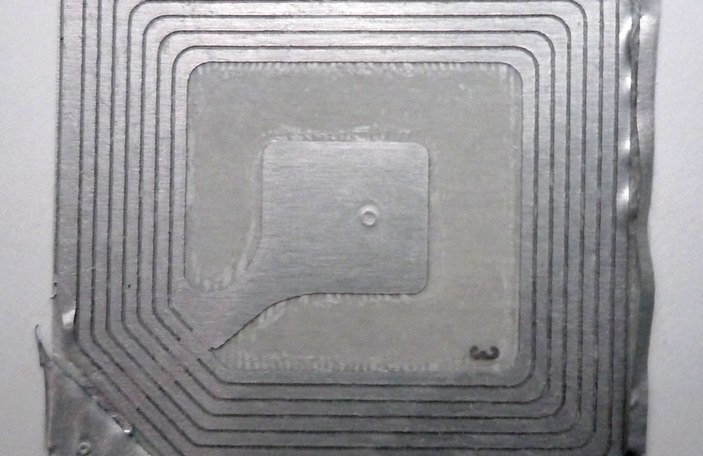
Impinj M800 UHF Inlay
Gen2X RAIN RFID

Quick answer
Impinj M800 series inlays carry the next-generation RAIN RFID tag chips — M830 (128-bit EPC, no user memory) and M850 (96-bit EPC + 32-bit user memory). Compared to the outgoing M700 (M730 / M750 / M770) family, M800 chips deliver ~1-2 dB read-sensitivity improvement (10-20% longer read range in the same antenna), ~30% lower chip power consumption (smaller / on-metal / on-liquid inlays that struggled on M700 now read reliably), wider tuning range for tighter RF stability, and faster inventory throughput via the Gen2X protocol enhancements. Pin- and protocol-compatible with M700 antenna designs — production lines and reader fleets upgrade without re-tuning. Five billion units shipped since launch (Impinj, Mar 2025); the volume next-gen choice for retail apparel mandates (Walmart / Inditex / Nike), supply-chain DC portals, and small-item industrial / pharma vials where M700 sensitivity left dB on the table.
- Next-generation sensitivity — ~1-2 dB improvement over M700 delivers 10-20% longer read range in the same antenna designs. Critical for small-antenna miniaturised inlays (jewellery / pharma vials / cosmetic samples) and on-metal / on-liquid applications where every dB recovers usable read distance.
- ~30% lower chip power + Gen2X protocol features — wider tuning range, tighter RF stability, faster inventory rounds, better dense-tag collision handling. Supports 1,000+ tags / minute encoding throughput on high-speed printer-applicator lines for billion-tag retail mandates.
- Pin- and protocol-compatible upgrade from M700 antenna designs — no antenna re-tune, no production-line revalidation, no reader-fleet re-qualification. Existing M700 antenna SKUs rebuild with M830 (128-bit EPC) or M850 (96-bit EPC + 32-bit user memory) chips, same converter tooling, same encoders.
Used in these industries
Deployments where this product is referenced on our industry landing pages.


At a glance
Use these short answers to decide whether this page matches the project before moving into the detail.
M800 family — the two chips that actually ship
M830 — 128-bit EPC, no user memory, no password memory. The volume retail-floor choice: lowest silicon cost, sensitivity identical to M850, default for apparel item-leve...
Sensitivity and read range vs M700
~1-2 dB read sensitivity improvement over M700 (M730 / M750 baseline) → typically 10-20% longer read range in the same antenna design. Real-world translation: M700-quali...
Next step
Ready to move forward? Start your inquiry to get specific answers for this project.
Request quote and samples- Power efficiency and on-metal / on-liquid behaviour
-
- ~30% lower chip power consumption vs M700 — the chip wakes and responds with less RF energy harvested from the reader carrier, which is what enables smaller / detuned antennas to read at usable distance.
- Combined effect of sensitivity + power efficiency: on-metal hang-tags, pharmaceutical vials, cosmetic samples, and electronics-component flags that needed compromises on M700 ship cleanly on M800.
- Same effect benefits high-density inventory reads — encoders and readers can run at lower duty cycle / lower transmit power while maintaining read rates, which matters for FCC dwell-time budgets at portal sites.
- Gen2X protocol features
-
- M800 chips support the Gen2X enhancements to the EPC Gen2v2 air-interface protocol — faster inventory rounds, more robust slot-count autotuning, better collision handling in dense-tag populations.
- Backward-compatible: Gen2X readers extract the faster behaviour; legacy Gen2v2 readers continue to interoperate with M800 tags at standard throughput.
- Practical result on high-speed printer-applicator lines (Printronix T8000, Zebra ZT411 / ZE521, SATO CL4NX): encoding throughput supports 1,000+ tags / minute, matching the requirements of billion-tag retail serialisation programmes.
- Air interface, standards, and reader compatibility
-
- ISO/IEC 18000-63 / EPC UHF Gen2v2 air interface, GS1-compliant. The same standard the entire installed reader base implements.
- GS1 EPC Tag Data Standard (TDS) 2.x SGTIN encoding for retail item-level; SSCC / GIAI / GRAI / GLN for non-retail.
- RAIN RFID Alliance certified; backward-compatible with all installed fixed-reader and handheld-reader hardware for standard read / write.
- Optional Impinj Protected Mode (privacy / supply-chain serialisation control — the tag refuses to respond to a generic inventory query until a key is presented). NOT a per-tap cryptographic chip-authentication feature; programmes needing the latter specify HF chips (NTAG 424 DNA / UCODE DNA), not UHF.
- Pin-compatible upgrade from M700 antenna designs
-
- M800 inlays use the same antenna designs as M700-series — no antenna re-tune, no production-line revalidation, no reader-fleet re-qualification needed for stock antennas.
- Migration workflow: order M830 or M850 inlays on the existing M700 antenna SKU; production line continues unchanged; readers see Gen2v2 tags either way.
- Plan transition 4-8 weeks ahead for stock antenna designs; 6-10 weeks if a new antenna is being engineered alongside the chip swap.
- Enduro data-protection technology
-
- Enhanced environmental stress tolerance vs previous-gen chips: -40 °C to +85 °C storage envelope.
- Improved high-humidity tolerance, ESD resilience, vibration resilience.
- Maintains data integrity through extreme supply-chain transit conditions (arctic cold storage, tropical humidity, desert heat, ocean freight).
- Procurement and lead times
-
- MOQ 10,000 pieces for stock antenna designs (M830 or M850).
- Lead time 4-6 weeks for stock antenna; 6-10 weeks for new antenna tooling.
- Sample sets of 100-500 pieces available for evaluation. Specify M830 vs M850 at the quote stage so the converter pulls the right chip-on-foil.
Why M800 matters at billion-tag scale
- Retail item-level tagging programmes encoding 10-50 billion tags annually need fastest possible write speeds. Gen2X encoding throughput improvement saves thousands of printer-applicator hours per year over a global SKU run.
- Miniaturised antennas for small items (cosmetics, electronics components, pharmaceutical vials) sacrifice read range; every dB of improved chip sensitivity directly translates to usable distance recovered. M800's ~1-2 dB matters more on a 20 × 5 mm pharma-vial inlay than on a 95 × 25 mm apparel label.
- Power efficiency at the chip level means lower transmit power at the reader can sustain the same read rate — useful at FCC-regulated portal sites where dwell-time budgets are tight.
- Interoperability across global RAIN RFID infrastructure: M800 implements the same EPC Gen2v2 air interface as M700 / UCODE 9 / Higgs-9. The installed reader base (fixed readers, handheld readers, printer-applicators) reads M800 tags without firmware updates or hardware changes.
M830 vs M850 — variant selection
M830 — volume retail-floor
- 128-bit EPC, no user memory, no password memory
- Lowest silicon ASP — the cost-optimised volume chip
- Default for apparel item-level tagging (Walmart / Inditex / Nike mandate volume)
- Cloud item-master holds everything beyond the SGTIN
- Same sensitivity floor as M850; choose for cost not range
M850 — supply-chain + on-tag data
- 96-bit EPC + 32-bit user memory + access / kill password memory
- Modest user-memory budget for lot codes, GS1 AI fragments, simple on-tag traceability data
- Supply-chain / logistics / mixed-application choice when small on-tag data avoids cloud round-trip
- Same sensitivity, same antenna compatibility as M830 — chip swap is per-SKU, not per-antenna
- Higher per-unit cost than M830 — earned only if user memory is actually written
From M700 launch 2018 to M800 next-gen volume floor
- 2018
Impinj M700 series ships at −22.7 dBm read sensitivity (M730 / M770; M750 -22.1 dBm), establishing the volume RAIN RFID floor for the next 5+ years. ARC Master List benchmarks at Auburn University RFID Lab define the procurement reference performance envelope.
- 2020-2022
Walmart RFID source-tag mandate scales across apparel + home + electronics + beauty; Monza R6 / R6-P (M730 / M750) ship into 5+ retail-floor categories at billion-tag-class daily volume.
- 2022
Impinj rebrands Monza R6 / R6-P silicon as M730 / M750 under M700-family naming refresh; existing inventory and ecosystem fully interoperable.
- 2023
Impinj announces M800 series (M830, M850) — ~1-2 dB sensitivity improvement, ~30% lower power, Gen2X protocol support, Enduro data protection. Pin- and protocol-compatible upgrade path for existing M700 antenna SKUs.
- March 2025
M800 series surpasses 5 billion lifetime units shipped — Impinj's fastest-growing tag chip ever. Walmart-class retail mandates and supply-chain DC portals adopting M830 as the volume next-gen floor; M850 ships into supply-chain and mixed-application programmes that write user memory.
- 2026 Today
Operating-playbook notes converge on M830 (volume retail-floor) and M850 (supply-chain + on-tag-data) at the chip layer + ARC-certified antenna at the inlay layer + dry / wet / converted-label form factor matched to converter or end-user workflow. Pin-compatible M700 → M800 migration runs in parallel with existing M700 production for the foreseeable transition window.
Useful next pages
Use these linked product, guide and comparison pages to keep the next click specific and practical.
Related UHF RFID inlay products
Compare with other UHF inlay options in the chip-family hierarchy.
Chip-level technical reference
Deep-dive specifications and chip-family comparisons relevant to this SKU.
Industry applications
Industry deep-dives where M800 series is specified.
FAQ
How does M800 compare to M700 in read range?
M800 delivers an estimated 10-20% longer read range than M700 in the same antenna design, due to ~1-2 dB sensitivity improvement and improved power harvesting / backscatter efficiency. In practical terms, an antenna that reads at 10 m with M700 reads at 11-12 m with M800. Exact improvement varies by antenna design and environment; small-antenna miniaturised applications (jewellery, pharma vials, cosmetic samples) see proportionally larger gains because that's where dB are hardest to recover.
Does M800 require new reader hardware?
No — fully backward-compatible with all existing RAIN RFID (UHF Gen2v2) reader hardware. Existing fixed readers, handheld readers, and printer-applicators work with M800 tags without firmware updates or hardware changes. Readers that natively support the Gen2X protocol enhancements will extract higher inventory throughput from M800 tags, but plain Gen2v2 readers continue to read them at standard throughput — no rollout gate.
Which M800 variant should a new programme specify — M830 or M850?
M830 (128-bit EPC, no user memory) for commodity retail item-level tagging where the cloud item-master is the source of truth and the SGTIN is the only on-tag payload — lowest silicon cost, the Walmart-mandate-class default. M850 (96-bit EPC, 32-bit user memory + password memory) when small on-tag data (lot codes, GS1 AI fragments, simple offline traceability) avoids a cloud round-trip, or when programmes specify access / kill passwords. Sensitivity is identical between the two — choose for memory and cost, not range. Mixing M830 and M850 within one programme is fine; the reader ecosystem handles both transparently.
When should I choose M800 over M700 or Higgs-9?
Choose M800 (M830 or M850) when you need next-gen sensitivity (small antennas, challenging RF environments), lower chip power consumption (smaller / on-metal / on-liquid inlays), or Gen2X encoding throughput for high-speed printer-applicator lines. Choose M700 (M730 / M750) for proven, cost-optimised general-purpose applications where the next-gen sensitivity premium isn't earned and existing inventory is already sourced. Choose Higgs-9 when 688-bit user memory is the dominating requirement (M850's 32-bit user memory is enough for lot codes; Higgs-9 is the choice for RTI trip logs, field-service records, and other large on-tag payloads).
What's the migration plan from M700 to M800?
Pin- and protocol-compatible — inlays qualified on M700 antenna designs rebuild with M830 or M850 chips on the identical antenna without antenna re-tune, reader-fleet re-qualification, or production-line encoding / print-apply re-validation. Plan transition 4-8 weeks ahead for stock antenna designs (production line continues unchanged); 6-10 weeks if a new antenna design is being engineered alongside the chip swap. Most retail mandates that are price-sensitive will stay on M730 (M700-family) until cost parity at the inlay level is reached; M800 adoption is led by programmes where the sensitivity / power-efficiency gain is operationally significant.
Does M800 support per-tap cryptographic authentication for luxury / pharmaceutical anti-counterfeit?
No — per-tap cryptographic authentication is not a shipping feature on M830, M850, or any other mainstream UHF RAIN RFID chip today (Impinj M700 / M800, NXP UCODE 9, Alien Higgs-9). The ISO/IEC 18000-63:2015 Amendment 1 AUTHENTICATE command framework exists as an optional standard but mainstream silicon does not implement it. M800 does support Impinj Protected Mode, which is a privacy / supply-chain serialisation control feature (the tag refuses to respond to a generic inventory query until a key is presented) — useful for preventing unauthorised inventory scans but NOT the same as a per-tag cryptographic chip-identity proof. Programmes that genuinely require per-tap cryptographic authentication (high-value luxury, pharmaceutical anti-substitution, premium spare-parts) specify HF chips such as NXP NTAG 424 DNA or UCODE DNA on a separate frequency band — typically deployed alongside, not instead of, a UHF inventory tag on the same product.
Sources & references
Primary standards, OEM datasheets and regulatory documents cited by this article. All URLs were verified on the access date shown below.
- Impinj M800 series tag chips — product page
Authoritative product page listing M830 and M850 specs, sensitivity, memory architecture, and feature support.
- Impinj Flagship M800 Series Tag Chips Surpass 5 Billion Lifetime Shipments
5-billion-unit milestone press release; references M830 and M850 only — establishes that no M860 / M870 / M880 variants ship.
- Impinj M800 Series Tag Chips Product Brief / Datasheet
Official product brief for M830 and M850.
- Impinj M830 / M850 series tag chip datasheet (mirror)
PDF mirror of the M830 / M850 datasheet with full memory, sensitivity, and Gen2X feature documentation.
- Impinj Protected Mode — what it is and what it isn't
Privacy / supply-chain serialisation feature on M800 series. Note: this is not a per-tap cryptographic authentication feature; for that, use HF chips such as NTAG 424 DNA.
- GS1 EPC UHF Gen2v2 Air Interface Protocol
Commercial protocol specification used across the RAIN RFID ecosystem; basis for M800 backward compatibility with existing reader fleets.
- ISO/IEC 18000-63:2015 Amendment 1 — Authentication mechanism
Defines the optional AUTHENTICATE command framework for EPC Gen2v2. The standard exists; mainstream RAIN RFID silicon (M700 / M800 / UCODE 9 / Higgs-9) does not currently implement it as a shipping feature.
- RAIN RFID Alliance
Industry consortium promoting UHF Gen2v2 interoperability; certification framework for M800 deployments.
- FCC Part 15 Subpart C §15.247 — 902-928 MHz operation
U.S. UHF RFID emission compliance basis for M800 reader-side regulatory operation.
- ETSI EN 302 208 — RFID equipment 865-868 MHz
European UHF RFID emission compliance basis for M800 reader-side regulatory operation.
Proud Tek is a Shenzhen-based RFID & NFC manufacturer supplying hotel chains, transit operators, event venues and retail brands worldwide. Every order includes free samples, RF testing and dedicated project support.
Get a Quick Quote
Tell us about your project and we'll respond within one business day. Fields marked (asterisk) are required.