
M700 UHF Inlays
Impinj M700-Series UHF Inlays
RAIN RFID, -22.7 dBm

Quick answer
This Impinj UHF inlay family-series UHF inlays embed the Monza M730 (retail item-level), M750 (mainstream logistics with user memory), or M770 (high-memory + AutoTune mixed-surface) chip in dry / wet / converted-label form factors with read sensitivity of −22.7 dBm (M730 / M770) and −22.1 dBm (M750) — the volume floor for new RAIN RFID deployments. They are the chip family behind the Walmart RFID retail mandate, retail item-level programmes (Macy's, Inditex, Nike, Lululemon), warehouse pallet portals, healthcare instrument tracking, and aerospace MRO supply-chain visibility. Retail loss-prevention, supply-chain, healthcare RTLS, and tier-1 manufacturing programmes use this as the chip / sensitivity / read-range / antenna-application / M800-upgrade-path reference.
- −22.7 dBm read sensitivity (M730 / M770; M750 -22.1 dBm) — 15-30% longer read range than M600-series predecessor at the same antenna footprint; the volume floor for new RAIN RFID deployments since 2018. Free-air bench 10-15 m with 6 dBic antenna at 4 W EIRP; real-world 5-10 m handheld retail, 3-8 m fixed-portal warehouse, 2-4 m healthcare small-item.
- M730 / M750 / M770 family — pure-EPC retail (M730), mainstream logistics + user memory (M750), high-memory + AutoTune mixed-surface (M770). All share the same sensitivity floor; antenna design and mounting surface dominate in-use range variation. ARC Master List + Walmart RFID + Auburn RFID Lab benchmark certified.
- Dry / wet / converted-label form factors across 15+ standard antenna designs (general-purpose, compact pharma / jewellery, on-metal, on-liquid, windshield, tire, woven care label, hang-tag) + custom antenna engineering 4-8 weeks. Pin- and protocol-compatible upgrade path to M800-series (M830 / M850) for Gen2X features, ~1-2 dB sensitivity gain, and ~30% lower chip power without antenna re-tune or reader-fleet re-qualification.
Used in these industries
Deployments where this product is referenced on our industry landing pages.


At a glance
Use these short answers to decide whether this page matches the project before moving into the detail.
M700 family — M730, M750, M770 positioning
M730 — mainstream retail workhorse: 96-bit EPC, minimal user memory, the volume chip for retail item-level programmes where the EPC serial is what matters. Default for a...
Air interface and standards
ISO/IEC 18000-63 / EPC Gen2v2 air interface; full Gen2v2 base command set including Untraceable on M770. GS1 EPC Tag Data Standard (TDS) encoding for SGTIN, SSCC, GIAI,...
Next step
Ready to move forward? Start your inquiry to get specific answers for this project.
Request quote and samples- Read sensitivity and range performance
-
- −22.7 dBm (M730 / M770) / −22.1 dBm (M750) read sensitivity at the chip — 15-30% longer read range than M600-series predecessor in identical antenna designs.
- Free-air bench: 10-15 m read range with 6 dBic CP antenna at 4 W EIRP.
- Real-world envelopes: 5-10 m handheld in retail, 3-8 m fixed-portal in warehouse, 2-4 m on healthcare small-item / liquid-adjacent / on-metal applications.
- Real-world range derating rule of thumb
-
- Retail apparel floor: divide datasheet range by 2× for actual operational read.
- Warehouse cases / pallet: divide by 3× — pallet contents, stretch-wrap, tag orientation all attenuate.
- Healthcare / pharma: divide by 4× — small antenna footprints, aqueous drug attenuation, dense packaging.
- On-metal / on-liquid: factor in 50-70% range reduction vs free-air; specify on-metal-tuned antenna or M770 AutoTune for consistency.
- Memory architecture
-
- M730: 128-bit EPC (configurable to 96-bit for SGTIN) + 96-bit serialised TID; no user memory.
- M750: 96-bit EPC + 96-bit serialised TID + 32-bit user memory (for short lot / date codes).
- M770: 128-bit EPC + 96-bit serialised TID + 64-bit user memory + Protected Mode + AutoTune.
- 32-bit access password + 32-bit kill password on all variants per EPC Gen2v2.
- Form factors — dry, wet, converted label
-
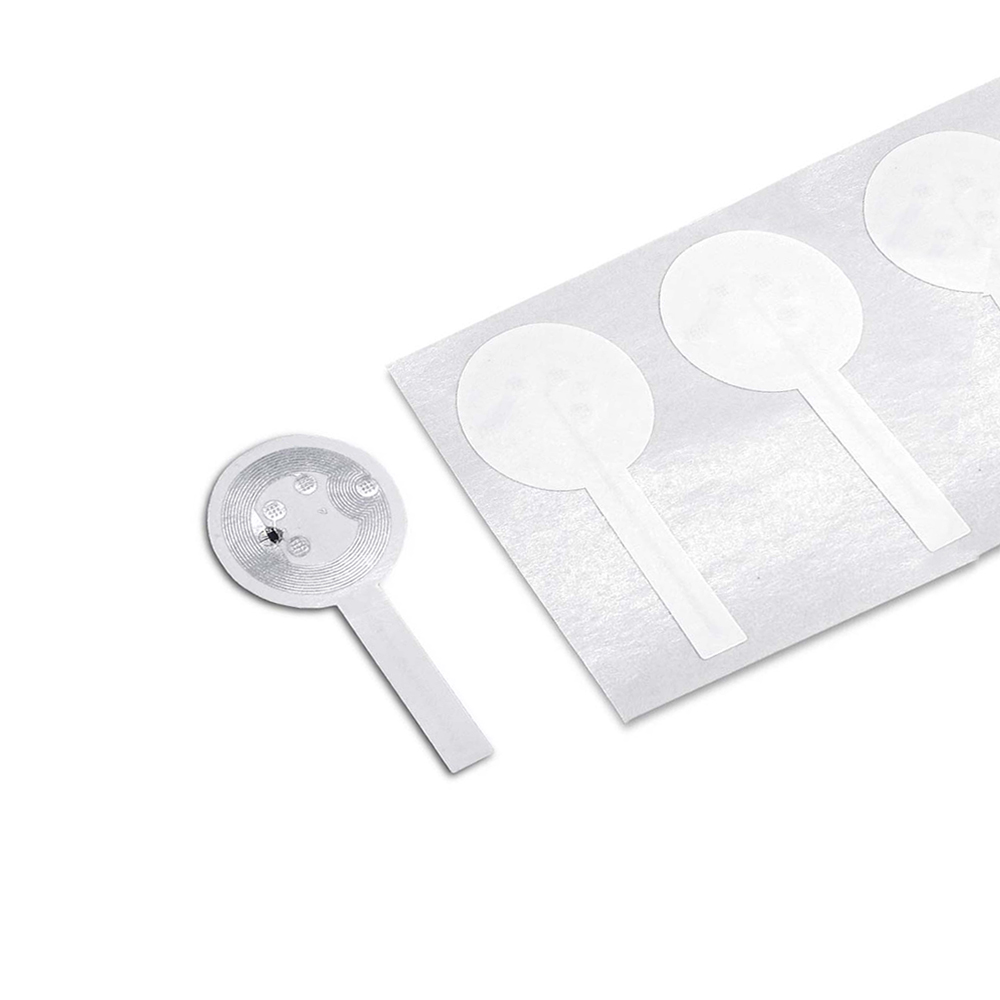
- Dry inlay: bare antenna + chip on a carrier substrate, no adhesive. For label converters laminating into their own label construction.
- Wet inlay: pressure-sensitive adhesive on release liner, ready to apply to any surface.
- Converted label: printed face stock (paper, PET, polypropylene) + adhesive + inlay; finished branded label ready for end-use application.
- Antenna designs available
-
- 15+ standard antenna designs: general-purpose far-field, compact (jewellery / pharma), on-metal, on-liquid, windshield, tire, woven care label, hang-tag.
- Custom antenna engineering 4-8 weeks for specialised applications — provide target read range, tag dimensions, mounting surface, environmental conditions.
- Smartrac, Avery Dennison, ARC Master List-certified antenna designs available across the M700 portfolio.
- Walmart RFID retail mandate alignment
-
- Walmart RFID source-tagging mandate (apparel since 2020, expanded to home / electronics / beauty 2022-2024) requires SGTIN encoding per GS1 TDS — M730 is the volume chip for source-tag compliance.
- ARC Master List spec category compliance (apparel, footwear, hard goods) — Auburn University RFID Lab benchmarks are the procurement reference.
- Adjacent retail mandates: Target, Macy's, Inditex, Nike, Lululemon, Kohl's all run on the same chip / antenna / encoding stack.
- Healthcare and pharmaceutical use
-
- DSCSA (U.S. Drug Supply Chain Security Act) + EU FMD (Falsified Medicines Directive) — RFID-on-pack pharmaceutical traceability with M730 / M750.
- Surgical instrument tracking, blood-bag identification, specimen-slide labelling — small-antenna inlays with high-sensitivity M700 chip recover range lost to miniaturisation.
- Healthcare RTLS adjacency — UHF inlays + ceiling readers for instrument / asset / patient-flow tracking.
- Aerospace and supply-chain MRO
-
- ATA Spec 2000 Chapter 9-5 RFID for aviation parts traceability; Boeing / Airbus tier-1 supplier requirement on rotable parts.
- Spec 2000 EPC encoding + serialised TID for unique-part identification across the part lifecycle.
- M750 with user memory for on-tag part-history payload where backend connectivity is unreliable.
- M700 → M800 upgrade path
-
- Pin- and protocol-compatible: inlays qualified on M700 antenna designs swap to M830 (128-bit EPC, no user memory) or M850 (96-bit EPC + 32-bit user memory) without antenna re-tune or reader-fleet re-qualification.
- M800 adds Gen2X protocol features (faster inventory, improved data integrity, optional Protected Mode for privacy / supply-chain serialisation control).
- ~1-2 dB sensitivity improvement (10-20% longer read range) and 30% lower power consumption at the chip level enable smaller / on-metal / on-liquid inlays that struggled on M700.
- Plan M700 → M800 transition 4-8 weeks ahead for stock antenna designs (production line continues unchanged) — longer if new antenna tooling is required.
- Procurement and validation
-
- Prototype quantities: 100-1,000 units; production: 100M+ units / year.
- On-site pilot validation recommended before committing to antenna choice — bench specs over-state real-world range; divide datasheet by 2-4× depending on application.
- Lead time: 4-6 weeks for standard antenna designs; 8-12 weeks for custom antenna development + production qualification.
Why M700 chip selection drives UHF deployment performance
- Read range in real-world environments runs 30-50% shorter than lab specifications. Building materials, metal shelving, liquid products, and dense item stacking attenuate UHF; chip sensitivity compensates.
- Dense reader environments (retail stores with multiple zones, warehouses with multiple portals) create RF interference. High-sensitivity chip maintains reliable reads in noisy RF where older chips experience read failures.
- Small-antenna inlays for compact labels (jewellery, pharmaceutical, small-item) deliver proportionally shorter read range; the M700's enhanced sensitivity recovers 20-40% of the range lost to antenna miniaturisation.
- Item-level tagging programmes in retail and healthcare require 99.5%+ read rates at operational speeds. Marginal improvements in chip sensitivity translate directly to fewer missed reads and higher deployment ROI.
M730 vs M750 vs M770 — which variant for which programme
M730 (volume retail) / M750 (mainstream logistics)
- M730: 96-bit EPC, no user memory, lowest per-unit cost — pure-EPC apparel / general-merchandise retail rollouts
- M750: 128-bit EPC + user memory (typically 32-128 bits) — logistics / healthcare with on-tag lot / date codes
- Within ~0.6 dB of each other (M730 / M770 at -22.7 dBm, M750 at -22.1 dBm) → range broadly comparable at chip level
- Antenna and mounting surface dominate in-use range variation
- ARC Master List spec category certified for retail mandate compliance
M770 (high-memory + AutoTune mixed-surface)
- M770: 128-bit EPC + 64-bit user memory + Protected Mode + AutoTune
- AutoTune adapts antenna match to mounting surface (metal, liquid, cardboard) without specifying surface-specific antenna
- Mixed-surface programmes: same SKU family across apparel + on-metal hang-tag + on-liquid gift set
- Premium per-unit cost vs M730 / M750 — earned by AutoTune flexibility
- Pin- and protocol-compatible upgrade path to M800 (M830 / M850) for Gen2X features and lower power on the same antenna
Datasheet range vs in-use range — derating rule of thumb
- Bench: 10-15 m free-air with 6 dBic CP antenna at 4 W EIRP.
- Retail apparel: 5-10 m handheld at walking speed, 2-5 m fixed-zone.
- Warehouse dock door: 3-6 m per portal, 99.5%+ read at 1-2 m/s forklift speed.
- Healthcare / pharma: 2-4 m typical due to small antenna + aqueous attenuation.
- Rule of thumb: divide datasheet range by 2× retail, 3× warehouse, 4× healthcare.
From EPC Gen2 v1 2004 to M700-series as RAIN RFID volume floor
- 2004
EPC Gen2 v1 standardised through EPCglobal; ISO/IEC 18000-63 Type C ratified subsequently. The protocol that every UHF inlay shipped today implements at the air-interface layer.
- 2008-2012
Walmart Phase 1 RFID pilot establishes the apparel item-level operational template; Inditex (Zara) deploys at brand-portfolio scale; supply-chain DC-portal programmes scale on Monza R6-class chips.
- 2015
ISO/IEC 18000-63 Amendment 1 publishes, adding the optional AUTHENTICATE command framework to EPC Gen2v2. The standard framework exists; mainstream RAIN RFID silicon (Impinj M700 / M800, NXP UCODE 8 / 9, Alien Higgs-9) does not currently implement it as a shipping crypto feature — programmes needing per-tap cryptographic authentication today specify HF chips such as NXP NTAG 424 DNA.
- 2018
Impinj M700-series ships with −22.7 dBm read sensitivity (M730 / M770; M750 -22.1 dBm) — 15-30% longer range vs M600 predecessor; ARC Master List benchmarks at Auburn University RFID Lab establish the procurement-reference performance envelope.
- 2020
Walmart RFID source-tag mandate scales to apparel across all suppliers; M730 emerges as the volume retail-floor chip; Macy's, Nike, Inditex, Lululemon mandates align on the same encoding / chip stack.
- 2022-2024
Walmart mandate expands to home / electronics / beauty / hardline; M730 / M750 ship into 5+ new retail-floor categories simultaneously. ATA Spec 2000 + DSCSA pharmaceutical adjacencies adopt M750 for user-memory-on-tag programmes.
- 2026 Today
Operating-playbook notes for retail-apparel-item-level, supply-chain-pallet, healthcare-asset-tracking, manufacturing-WIP, and aerospace-MRO programmes converge on M730 (pure-EPC retail) / M750 (logistics + user memory) / M770 (mixed-surface) at the chip layer + ARC-certified antenna at the inlay layer + dry / wet / converted-label form factor matched to converter or end-user workflow as the operator-side template. M800 (M830 / M850) upgrade path runs in parallel for next-gen power efficiency and Gen2X protocol features on the same antenna designs.
M700 family at a glance
- M730 — mainstream retail workhorse; 96-bit EPC, minimal user memory; default for apparel and general-merchandise.
- M750 — volume production with user memory; 128-bit EPC + on-tag lot / date codes; logistics / healthcare workhorse.
- M770 — high memory + AutoTune; mixed-surface flexibility; premium per-unit cost earned by surface-adaptive performance.
- M730 / M770 share −22.7 dBm sensitivity; M750 at −22.1 dBm (~0.6 dB difference) — antenna design and mounting surface dominate in-use range variation.
- Pin- and protocol-compatible upgrade to M800 (M830 / M850) for Gen2X features, ~30% lower power consumption, and ~1-2 dB sensitivity improvement on the same antenna design.
Useful next pages
Use these linked product, guide and comparison pages to keep the next click specific and practical.
Related UHF RFID inlay products
Other UHF inlay and label solutions in the chip-family hierarchy.
Chip-level technical reference
Deep-dive specifications and chip-family comparisons relevant to this SKU.
Industry applications
Industry deep-dives where this SKU is commonly specified.
FAQ
What is the read range of the Impinj M700 inlay?
Read range depends on antenna design and application environment. Free-air bench: 10-15 m with a standard 6 dBic CP antenna at 4 W EIRP. Real-world: 5-10 m handheld in retail, 3-8 m fixed-portal in warehouse, 2-4 m on healthcare small-item / on-liquid / on-metal applications. Always derate datasheet range by 2× for retail, 3× warehouse, 4× healthcare. Validate with on-site pilot before committing to antenna choice.
What is the difference between dry inlay, wet inlay, and converted label?
Dry inlay: bare antenna + chip on a carrier substrate, no adhesive — for label converters laminating into their own construction. Wet inlay: pressure-sensitive adhesive on release liner, ready to apply directly. Converted label: printed face stock (paper, PET, polypropylene) + adhesive + inlay = finished branded label ready for end-use. Choose dry for converter integration, wet for direct application, converted for branded-label end-use.
Can I get the M700 in a custom antenna design?
Yes — beyond 15+ standard antenna designs, custom antenna engineering for specialised applications. Provide target read range, tag dimensions, mounting surface material, and environmental conditions; RF engineering team designs and prototypes a custom antenna optimised for the use case. Typical custom antenna development: 4-8 weeks. ARC Master List + Auburn University RFID Lab certification available for retail-grade performance benchmarks.
Which M700 variant should I specify for a new apparel item-level programme?
Pure-EPC apparel rollout (no on-tag user data, EPC is the handle into cloud item master): M730 — volume choice, lowest per-unit cost. M750 if encoding workflow writes lot / date codes / short serial into user memory alongside EPC. M770 if same SKU family applies across mixed surfaces (some apparel, some on-metal hang-tags, some on liquid-containing gift sets) where AutoTune earns its premium. M730 / M770 share −22.7 dBm sensitivity; M750 sits at −22.1 dBm — swapping M730 ↔ M750 mid-programme costs ~0.6 dB at the chip level, mostly absorbed by antenna design margin.
What is the migration path from M700 to M800?
Pin- and protocol-compatible. Inlays qualified on M700 antenna designs rebuild with M830 (128-bit EPC, no user memory) or M850 (96-bit EPC + 32-bit user memory) chips on the identical antenna without antenna re-tune, reader-fleet re-qualification, or production-line encoding / print-apply re-validation. M800 family adds Gen2X protocol features (faster inventory, improved data integrity), ~30% lower chip power consumption, ~1-2 dB sensitivity improvement, and optional Impinj Protected Mode for privacy / supply-chain serialisation control. Plan M700 → M800 transition 4-8 weeks ahead for stock antenna designs; longer if new antenna tooling is required.
How does the M700 compare to NXP UCODE and Alien Higgs?
M700 (-22.1 to -22.6 dBm sensitivity across M730 / M750 / M770 variants) is the volume retail / logistics chip; ARC Master List dominant. NXP UCODE 8 / 9 (-23 / -23.5 dBm respectively) is the European-incumbent alternative, also Walmart-mandate compatible; UCODE 9 has the best-in-class sensitivity of the volume RAIN tier and is the choice for freezer / dense-reader / long-range applications. Alien Higgs-9 offers 688-bit user memory (largest in commodity UHF) at slightly higher sensitivity than M700 (-23.2 dBm typical); the right answer when on-tag user data dominates the use case. Detailed compare on the UCODE-vs-UCODE-vs-Monza-vs-Higgs page.
Sources & references
Primary standards, OEM datasheets and regulatory documents cited by this article. All URLs were verified on the access date shown below.
- ISO/IEC 18000-63:2015 — RFID for item management — Air interface 860-960 MHz Type C (EPC Gen2)
UHF RFID air-interface standard for the M700-series chip + every modern RAIN RFID deployment.
- Impinj M700-series RFID tag chips — product page and data sheet
Authoritative chip-level reference for M730 / M750 / M770 sensitivity, memory, AutoTune (M770), and antenna-design compatibility.
- GS1 EPC Tag Data Standard (TDS) — EPC encoding scheme for UHF Gen2
EPC encoding standard governing SGTIN / SSCC / GIAI / GLN encoding on M700 inlays for retail and supply-chain compliance.
- RAIN RFID Alliance — technology overview and application profiles
Industry-alliance reference for RAIN RFID certification, application profiles, and read-range test methodology.
- FCC 47 CFR Part 15.247 — operation within 902-928 MHz (US ISM band for UHF RFID)
Reader-side regulatory baseline for UHF RFID in North America — 36 dBm EIRP cap.
- ETSI EN 302 208 — RFID equipment 865-868 MHz (EU UHF RFID)
Reader-side regulatory baseline for UHF RFID in EU/UK — 33 dBm ERP with LBT.
- Auburn University RFID Lab — ARC Master List specifications
Procurement-reference benchmark for retail-grade UHF inlay performance under Walmart-aligned ARC Master List specifications.
- Walmart RFID source-tagging mandate — public communications
Reference retail-mandate framework that scaled M730 into apparel + home + electronics + beauty source-tagging across the U.S. retail supply chain.
- ATA Spec 2000 Chapter 9-5 — RFID for aerospace parts traceability
Aerospace MRO reference standard for UHF inlay deployments on rotable parts and supply-chain visibility programmes.
- ISO/IEC 18000-63:2015 Amendment 1 — Authentication mechanism
Defines the optional AUTHENTICATE command framework for EPC Gen2v2. The standard exists; mainstream RAIN RFID silicon does not currently implement it as a shipping feature.
Proud Tek is a Shenzhen-based RFID & NFC manufacturer supplying hotel chains, transit operators, event venues and retail brands worldwide. Every order includes free samples, RF testing and dedicated project support.
Get a Quick Quote
Tell us about your project and we'll respond within one business day. Fields marked (asterisk) are required.