
Access Control
How NFC Door Locks Work with RFID Cards

Quick answer
A technical guide to NFC-based door-lock systems — and how to tell a genuinely secure lock from one running on hope. Covers lock architectures, card-authentication protocols, credential encoding, lock-management software and security best practices for B2B access-control buyers deploying smart locks in hotels, offices and multi-tenant buildings.
- NFC door locks authenticate RFID cards using cryptographic challenge-response protocols, preventing the replay and cloning attacks that compromise legacy magnetic-stripe and 125 kHz proximity systems.
- Offline NFC locks store authorization data on the card itself, eliminating the need for real-time network connectivity at every door. Critical for hotels and remote facilities.
- Online NFC locks communicate with a central access-control server in real time, enabling instant credential revocation, audit logging and integration with building management systems.
At a glance
Use these short answers to decide whether this page matches the project before moving into the detail.
Key takeaway
NFC door locks authenticate RFID cards using cryptographic challenge-response protocols, preventing the replay and cloning attacks that compromise legacy magnetic-stripe and 125 kHz proximity systems.
How NFC door locks authenticate an RFID card
Every hotel guest has run the same ritual: tap the card, wait for the little green light, push the door open. The whole thing feels like nothing happened. But in that on...
Next step
Ready to move forward? Start your inquiry to get specific answers for this project.
Get lock-system adviceHow NFC door locks authenticate an RFID card
Every hotel guest has run the same ritual: tap the card, wait for the little green light, push the door open. The whole thing feels like nothing happened. But in that one tap, the lock and the card either ran a real cryptographic conversation or they didn't — and that difference decides whether an off-the-shelf cloning gadget is enough to open the door. When a guest or employee presents an RFID card to an NFC door lock, a multi-step authentication and authorization process occurs within milliseconds. Understanding this process helps B2B buyers evaluate lock-system security claims.
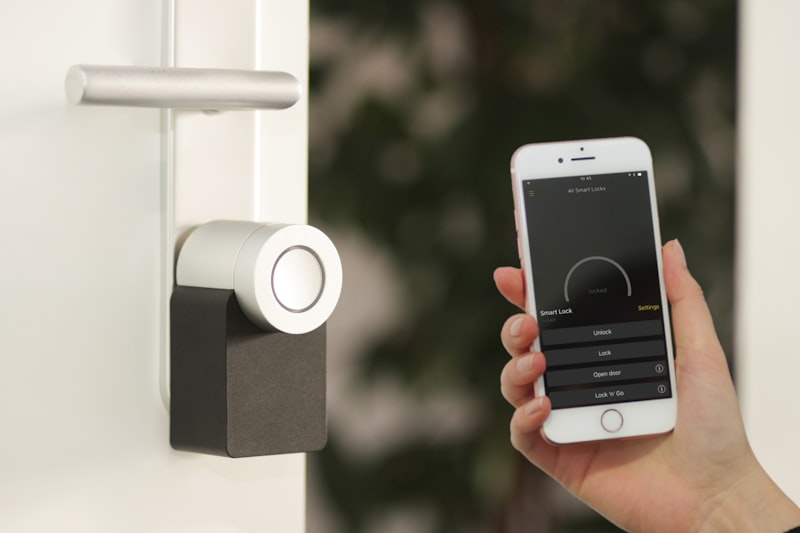
The lock's NFC reader powers the card via the 13.56 MHz field and reads the card's UID (unique identifier). For basic systems, the UID alone may be checked against a whitelist. For secure systems using MIFARE DESFire or similar smart cards, the lock initiates a mutual-authentication handshake: both the lock and the card prove knowledge of a shared secret key using AES-128, without the key ever being transmitted over the air.
- UID-only authentication is insecure. UIDs can be cloned with inexpensive NFC tools — a UID is a name tag, not a password, and checking it proves only that the card is willing to say who it is. Never rely on UID alone for access control in production.
- Mutual authentication (AES challenge-response) ensures both the lock and the card verify each other's identity before granting access.
- After authentication, the lock reads authorization data from the card (room number, validity period, access-level flags) and makes a grant/deny decision locally.
- The entire authentication and read process completes in 100–300 ms, perceived by the user as instantaneous.
What's the difference between offline and online lock architectures?
NFC door locks are deployed in two primary architectures (offline (card-centric) and online (server-centric)) each with different infrastructure requirements, security properties and operational characteristics.
| Feature | Offline (card-centric) | Online (server-centric) |
|---|---|---|
| Network requirement | None at the door | Wired or wireless to each lock |
| Authorization data location | Encoded on the card | Server database, pushed to lock |
| Credential revocation speed | Next card presentation at encoder | Immediate (server pushes to lock) |
| Lock battery life | 2–4 years (no network radio) | 6–18 months (Wi-Fi/BLE radio active) |
| Audit trail retrieval | Collected when card visits encoder or lock is read | Real-time via network |
| Scalability | Unlimited doors without network infrastructure | Limited by network coverage and bandwidth |
| Typical application | Hotels, dormitories, remote facilities | Corporate offices, data centers, government |
How do you handle card credential encoding and management?
The data written to the RFID card determines which doors the cardholder can open and for how long. Credential encoding is performed at front desks, security offices or kiosks using USB NFC readers and lock-vendor software.
- Hotel key cards encode room number, arrival date, departure date, common-area access flags (pool, gym, parking) and a card-sequence counter for re-encoding detection.
- Corporate access cards encode a cardholder ID that maps to access-level groups in the lock-management database.
- Diversified keys ensure each lock uses a unique encryption key derived from a master key. Compromising one lock does not expose the entire system.
- Card blacklisting on offline systems is propagated via staff cards or mobile devices that carry blacklist updates and transmit them to locks during routine property walks.
- Re-encoding a card invalidates the previous card automatically via a sequence counter. The lock rejects any card with a lower sequence number than the most recently presented card.
What are the security best practices for NFC lock deployments?
Deploying NFC locks securely requires attention to key management, card lifecycle, firmware maintenance and physical security of the lock hardware. The cryptography is usually the easy part; it's the master key on a sticky note in the back office that quietly undoes most deployments.
- Use MIFARE DESFire EV2 or EV3 for all new lock deployments. Avoid MIFARE Classic (Crypto-1 is compromised) and UID-only authentication.
- Implement diversified keys using AES CMAC key derivation. Never use the same static key across multiple locks.
- Rotate master keys annually and maintain offline backup copies in a physically secure location.
- Enable lock-audit-trail collection and review access logs for anomalies. Repeated denied accesses, off-hours entries, or cards used after checkout.
- Keep lock firmware updated to patch known vulnerabilities. Establish a maintenance schedule for firmware pushes via staff cards or BLE.
- Physically secure the lock's interior components. Tamper switches should trigger lockout mode if the lock housing is opened.
How does it integrate with building management systems?
In corporate and multi-tenant buildings, NFC door locks are one component of a broader building-management ecosystem that includes elevators, HVAC, lighting and video surveillance.
- OSDP (Open Supervised Device Protocol) is replacing legacy Wiegand as the standard interface between NFC readers and access-control panels, providing encrypted bidirectional communication.
- BACnet and Modbus integrations allow NFC card presentations to trigger HVAC set-point changes, lighting scenes and elevator dispatching.
- Video-management system (VMS) integration correlates NFC access events with camera feeds for forensic review.
- Visitor-management systems issue temporary NFC credentials with time-bound and area-restricted access. Automatically expiring at the end of the scheduled visit.
How are mobile credentials (Apple Wallet, Google Wallet, Aliro) reshaping NFC door locks?
The 2024-2026 wave of mobile credential standards has changed the lock-procurement decision. A lock spec'd today must support both physical RFID cards and at least one mobile credential framework — otherwise it's obsolete by year 2 of the deployment.
- Apple Home Key and Wallet keys: Apple's Wallet now stores digital keys for homes, hotel rooms, offices, schools, cars and scooters. iPhone or Apple Watch unlocks via NFC tap with the device within ~1 inch of the lock. Express Mode keeps the credential active even with a fully black screen — critical for hospitality user experience.
- Apple's iOS 18.1 NFC and Secure Element opening: Apple introduced expanded NFC and Secure Element access in iOS 18.1 for in-app contactless beyond Apple Pay — including badges, keys and tickets. This is the technical change that finally lets non-Apple-partner credential providers issue Wallet-grade keys on iPhone, opening up far broader smart-lock interoperability.
- Google Wallet keys: Android's equivalent for hotel and office mobile credentials, increasingly bundled with hotel chain apps (Hilton Honors, Marriott Bonvoy) and smart-home lock vendors (August / Yale, Schlage).
- Aliro 1.0 (Connectivity Standards Alliance, released 26 February 2026): the new cross-vendor mobile-credential standard for corporate offices, universities, hospitality, single-family and multi-family homes — designed to work even without network coverage. Aliro is to mobile credentials what Matter is to smart-home control.
- Procurement implication: any new lock spec in 2026 should require AES-128 mutual auth (DESFire EV2/EV3), OSDP for reader-to-panel encryption, and explicit Aliro and/or Apple Home Key + Google Wallet roadmap. Locks that only do MIFARE Classic UID checks will be replaced inside 3-5 years.
Useful next pages
Use these linked product, guide and comparison pages to keep the next click specific and practical.
Hotel key cards
Pre-programmed and blank RFID key cards compatible with major hotel lock vendors.
High-security access cards
MIFARE DESFire cards for corporate and government access-control deployments requiring AES-128 authentication.
FAQ
Can NFC door locks work without internet connectivity?
Yes. Offline NFC locks are specifically designed for environments without network connectivity at the door. All authorization data is encoded on the card and validated locally by the lock. This architecture is standard in hotels, cruise ships and remote facilities.
What RFID chip should I specify for high-security door locks?
MIFARE DESFire EV2 or EV3 with AES-128 mutual authentication and diversified keys. Avoid MIFARE Classic (known vulnerabilities) and 125 kHz proximity cards (no authentication). For the highest security, consider Java Card-based credentials with PKI certificate authentication.
How long do batteries last in NFC door locks?
Offline NFC locks running on 4 AA batteries typically last 2–4 years or 30 000–50 000 openings. Online locks with Wi-Fi or BLE radios consume more power and last 6–18 months. Low-battery indicators warn maintenance staff 2–4 weeks before replacement is needed.
Should new lock deployments support Apple Home Key, Google Wallet and Aliro?
Yes — at minimum a clear roadmap. Apple Home Key (iOS 15+) and Google Wallet keys are now common in hospitality (Hilton, Marriott, Hyatt) and increasingly in residential and office. Apple's iOS 18.1 NFC and Secure Element opening expanded which credential providers can issue Wallet-grade keys on iPhone, broadening compatibility. The Connectivity Standards Alliance released Aliro 1.0 on 26 February 2026 as a cross-vendor mobile credential standard for offices, universities, hospitality, single-family and multi-family homes. Locks specified in 2026 without an Aliro / Apple Home Key / Google Wallet roadmap will be replaced inside 3-5 years; physical RFID cards will remain the fallback but mobile must work for premium guest and employee experience.
What's the right way to handle credential revocation across offline and online locks?
For online locks, revoke at the central server and the next attempted swipe is denied immediately. For offline locks, two patterns work: (1) blacklist propagation — staff cards or maintenance-tablet BLE pushes blacklist updates as part of routine property walks, typical refresh 12-48 hours; (2) sequence counter invalidation — re-issuing a higher-sequence card to the same room automatically invalidates the previous card on the next presentation, the standard hospitality flow for guests changing rooms or staying past initial check-out. For mobile credentials (Apple Wallet, Google Wallet, Aliro), revocation is server-pushed to the user's device at next network sync, typically near-real-time. Best practice for high-security deployments: combine all three — online server, offline blacklist propagation and per-card sequence counters — so no single failure mode leaves a revoked credential active.
Proud Tek is a Shenzhen-based RFID & NFC manufacturer supplying hotel chains, transit operators, event venues and retail brands worldwide. Every order includes free samples, RF testing and dedicated project support.
Get a Quick Quote
Tell us about your project and we'll respond within one business day. Fields marked (asterisk) are required.