
Fixed UHF RFID Reader
Fixed UHF RFID Reader
Portal & Dock-Door

Quick answer
At BOM level, fixed UHF RFID readers are the enterprise-grade radios that sit permanently at a dock door, portal, conveyor, overhead zone or retail ceiling array. Proud Tek supplies and integrates the major fixed-reader platforms — Impinj R700 and Speedway R420, Zebra FX9600 and FX7500, Alien ALR-F800, CAEN R1260 and A949EU, Nordic ID HH85 AIR, Feig ID ISC.LRU3500. With 4- or 8-port antenna configurations, LLRP and Octane / Zebra RFID SDK integration, PoE+ power and regional-firmware certification for US / EU / APAC deployments.
- Major-brand fixed UHF readers in one catalogue — Impinj R700 and R420, Zebra FX9600 and FX7500, Alien ALR-F800, CAEN R1260, Nordic ID HH85 AIR, Feig ISC.LRU3500 — with 4 or 8 monostatic antenna ports, +30 to +36 dBm EIRP per port and GigE + PoE+ host.
- Software-first integration: native LLRP (ISO/IEC 19762) on every reader, plus vendor SDKs (Impinj Octane IoT-DI with REST + MQTT, Zebra RFID SDK for Android / C / Java / .NET, CAEN LLRP extension library, Feig FEDM) and reference integrations for sllurp, LTK and OctaneSDK.
- Regional firmware matched to deployment country. FCC 902-928 MHz (US / Canada ISED), ETSI EN 302 208 v3.3.1 865.6-867.6 MHz (EU / UK), SRRC 920-925 MHz (China), ARIB STD-T106 (Japan), ANATEL (Brazil), KS X (Korea), TELEC (Japan secondary).
Used in these industries
Deployments where this product is referenced on our industry landing pages.

At a glance
Use these short answers to decide whether this page matches the project before moving into the detail.
EPC Gen2 + ISO/IEC 18000-63 air-interface
EPC Gen2 v2.1 / ISO/IEC 18000-63 UHF air-interface at 860-960 MHz (regional band) with Q-algorithm anticollision, FM0 / Miller-subcarrier signalling and dense-reader mod...
Antenna port configuration
4 port SKUs (Impinj R420, R700 base, Zebra FX9600 4-port, Alien ALR-F800 4-port, CAEN R1260 4-port) for typical dock-door + portal zones. 8 port SKUs (Impinj R700-8, Zeb...
Next step
Ready to move forward? Start your inquiry to get specific answers for this project.
Request fixed-reader samples and site-survey proposal- Regional firmware certification
-
- FCC 47 CFR Part 15.247 — 902-928 MHz, +36 dBm EIRP max with 6 dBi antenna, 50-channel frequency-hopping spread spectrum, US + Canada (ISED RSS-247).
- ETSI EN 302 208 v3.3.1 — 865.6-867.6 MHz + 915-921 MHz extended upper band, +33 dBm ERP, LBT (listen-before-talk) for EU + UK.
- SRRC MIIT 920-925 MHz China, ARIB STD-T106 + Japan Radio Law Art. 2-1-19 (916.7-923.5 MHz), KCC KS X 6905 Korea, ANATEL Brazil (902-907.5 + 915-928 MHz), TELEC Japan secondary.
- LLRP + vendor SDK stack
-
- LLRP (Low-Level Reader Protocol) per ISO/IEC 19762 on TCP port 5084 — vendor-neutral RoSpec / AccessSpec / ROReport control channel available across Impinj, Zebra, Alien, CAEN, Feig, Nordic ID.
- Vendor SDKs: Impinj Octane SDK + IoT Device Interface (REST + MQTT), Zebra RFID SDK (Android / C / Java / .NET), CAEN easy2read + A927Z, Feig FEDM (C / C++ / Java / .NET), Alien Gateway API.
- Open-source libraries: sllurp (Python), LTK (Java, C, C#), go-llrp (Go), octane-llrp (Impinj community) for multi-vendor middleware builds.
- PoE+ + host interface envelope
-
- GigE (1000BASE-T) + PoE+ IEEE 802.3at 25.5 W at port on all modern readers; PoE++ 802.3bt 60 W on ATR7000 overhead array.
- Wi-Fi 5/6 on R700 firmware 1.11+ and FX9600 optional for retail-ceiling or showroom installs without cabled infrastructure.
- Serial console via USB-C for setup + GPIO ports for light-tower / shift-trigger / conveyor-PLC integration.
- Environmental + IP envelope
-
- Indoor IP51 on standard R700 / FX9600 / ALR-F800 — dust-protected, no water ingress protection beyond vertical drip.
- Outdoor IP65 / IP67 variants (CAEN R1260I, Feig ISC.LRU3500-IP, Impinj R700 outdoor enclosure) for yard-gate, rail-siding and loading-bay deployments.
- Operating range -10 to +55 °C standard; -20 to +60 °C outdoor SKUs.
- On-reader edge processing
-
- Impinj R700 — 1.6 GHz dual-core Cortex-A9, 1 GB RAM, 4 GB flash, Linux + OCI container runtime for edge-filter, tag-dwell, duplicate-suppression logic and direct MQTT / Kafka publish.
- Zebra FX9600 — 800 MHz PowerPC, Java application framework for on-reader logic (Zebra RFID Application), supported since FX7400 generation.
- Impinj ItemSense, Zebra Savanna edge, CAEN easy2read middleware + GS1 EPCIS upconverter on the local edge-gateway sit between reader and cloud for enterprise-grade deployments.
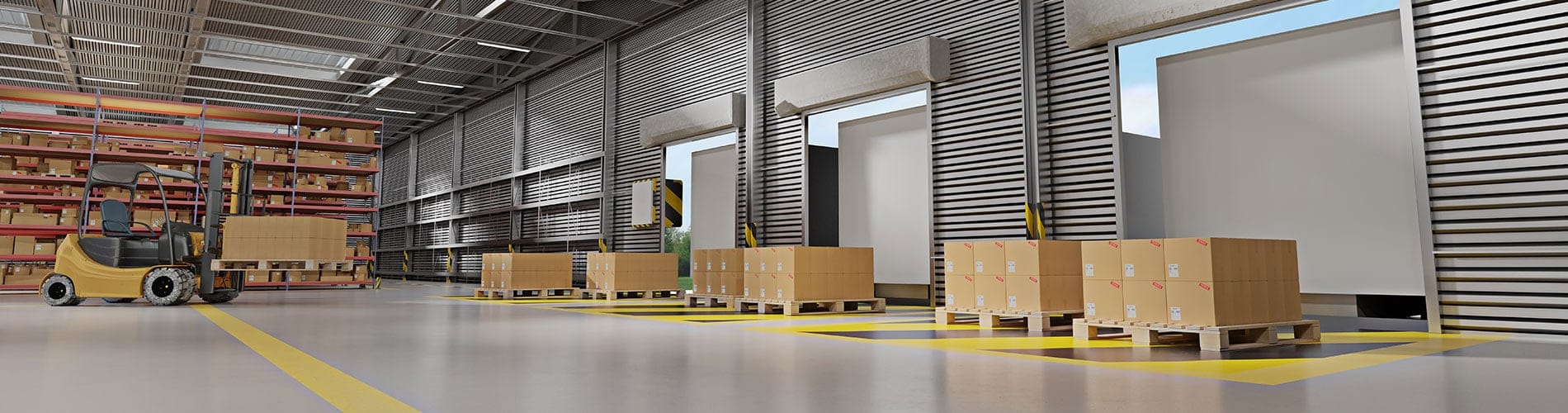
- Dock-door + portal logistics
-
- 4-antenna dock-door portal: one antenna pair at ~1.0 m height per door jamb + one overhead per door. Inbound / outbound direction inferred from per-antenna RSSI and read sequence.
- Yard-gate outdoor deployment: CAEN R1260I or Feig ISC.LRU3500-IP + bistatic long-range antennas at 5-8 m for container / trailer / tractor-trailer identification.
- Conveyor-lane checkpoint: single R700 + 2 port tunnel antenna pair at 30-60 cm for parcel-lane inventory-commissioning on warehouse sorter.
- Retail ceiling array
-
- Zebra ATR7000 overhead 8-port array mounted at 3-4 m in fashion-apparel store, backing SmartSense for 98-99 % store-floor inventory accuracy per published Auburn U RFID Lab retail benchmarks.
- Impinj xSpan ceiling readers for 100-300 m² zone inventory, integrated under Impinj ItemSense or Detego RFID retail platform.
- Typical retail deployment: 1 ceiling reader per 80-150 m² of shop-floor + 1 fitting-room reader + 1 POS exit portal.
- Automotive tire exit portal
-
- EU Tire Regulation (EU) 2024/1257 mandates finished-tire traceability; RFID-tagged tires exit via a portal with 2× panel antennas at 1.2 m height + overhead antenna to confirm batch + DOT serial per exiting pallet.
- Typical portal: 4-port R700 or FX9600 + Times-7 A5010 near-field or MT-262013 far-field antennas + PLC handshake to the loading-bay conveyor.
- GS1 EPCIS 2.0 event-log format is the canonical downstream schema for tire-OEM track-and-trace compliance.
- Regulatory + deployment posture
-
- FCC Part 15.247 (US / Canada), ETSI EN 302 208 v3.3.1 (EU / UK), SRRC (China), ARIB STD-T106 (Japan), ANATEL (Brazil), KCC (Korea): country-specific firmware images — match to destination before factory-acceptance testing.
- Regulatory-audited downstream frameworks: EU Tire Regulation 2024/1257, FDA DSCSA (21 CFR Part 11), ATA Spec 2000 aerospace MRO, GS1 EPCIS 2.0 track-and-trace, 21 CFR Part 820 medical-device UDI.
At-a-glance — antenna ports, EIRP envelope and throughput
Handheld-only workflow vs fixed-reader portal + dock-door array
Throughput benchmark — Auburn U RFID Lab + Impinj dense-reader published data
When a fixed UHF reader is the right choice
- Fixed-location throughput workflow (dock door, portal, overhead conveyor, retail ceiling array, yard gate, production-line checkpoint) where tagged goods pass a defined zone under the reader's RF field.
- High-tag-population inventory. A single FX9600 or R700 at +33 dBm can inventory 300-600 tags per second with a Q-algorithm optimised for crowd scenes; no handheld achieves that throughput.
- Continuous operation, network-integrated. Fixed readers run 24/7 on PoE+ or 12-24 V DC, stream tag events over LLRP / MQTT / Kafka to a middleware or cloud endpoint, and are managed from a central fleet controller (Impinj ItemSense, Zebra Savanna, or a custom IoT gateway).
- Regulatory-audited deployments: EU Tire Regulation (2024/1257) finished-tire-exit portals, FDA DSCSA pharmaceutical packaging, ATA Spec 2000 aerospace MRO and GS1 EPCIS track-and-trace all require fixed reader arrays for their enforcement zones.
Technical specification and configuration options
- Antenna ports — 4 port (R420, R700 base, FX9600 4-port, ALR-F800 4-port) or 8 port (R700-8, FX9600 8-port, ATR7000 overhead array). Monostatic (single antenna TX + RX) is standard; bistatic configurations available on CAEN A949EU for long-range outdoor yards.
- RF output power — +30 dBm (1 W) to +33 dBm (2 W) per port on EU firmware, up to +36 dBm (4 W EIRP with 6 dBi antenna) on FCC firmware per 47 CFR 15.247 limits. Software-adjustable per port.
- Antennas (sold separately) — 6 dBi circularly polarised near-field (Times-7 A5010, Laird S9028), 9 dBi CP far-field (MT-262013, Times-7 A6034), 12 dBi linear polarised long-range (MTI MT-263013, Laird S9028PCLJ), and overhead arrays (Zebra AN620, Impinj xArray-integrated).
- Host interface: GigE + PoE+ (802.3at, 25.5 W at port) on all modern readers, with Wi-Fi 5/6 on R700 firmware 1.11+ and FX9600 optional; serial console via USB-C for setup; GPIO for trigger / shift / light-tower integration.
- Power: PoE+ (25.5 W) or 24 V DC barrel jack. A fully-loaded 8-port R700 at maximum EIRP draws ~22 W; an 8-port FX9600 draws ~28 W; an ATR7000 overhead array draws up to 40 W and requires PoE++ (802.3bt) or external DC.
- Environmental: indoor IP51 standard (R700, FX9600, ALR-F800). IP65/IP67 outdoor variants (CAEN R1260I, Feig ISC.LRU3500-IP) for yard, gate and outdoor-portal deployments. Operating range -10 to +55 °C (standard), -20 to +60 °C (outdoor SKUs).
- On-reader processing: Impinj R700 ships with a 1.6 GHz dual-core Cortex-A9, 1 GB RAM and 4 GB flash for running edge-filter, tag-dwell and duplicate-suppression logic on the reader itself; Zebra FX9600 ships with an 800 MHz PowerPC and supports Java application development (Zebra RFID Application) for similar edge-processing.
Software, SDK and integration options
- LLRP (Low-Level Reader Protocol, ISO/IEC 19762). The open, vendor-neutral standard. Port 5084 TCP, binary message framing, RoSpec / AccessSpec / ROReport lifecycle. All readers in this catalogue ship with LLRP natively. Reference libraries: LTK (Java, C, C#, C++, Python), sllurp (Python), octane.llrp (Impinj), go-llrp (Go).
- Impinj Octane IoT Device Interface (IoT-DI). Higher-level REST + MQTT endpoints on R700 firmware 1.11+. The reader publishes tag-event JSON to an MQTT broker (Mosquitto, HiveMQ, AWS IoT Core) or Kafka topic without middleware. Recommended integration pattern for cloud-native deployments.
- Zebra RFID SDK for Android / C / Java / .NET. Cross-family SDK covering FX9600, FX7500 fixed plus RFD40, RFD90 handheld sleds. One API, two form factors. The main reason Zebra-shop deployments tend to stay Zebra end-to-end.
- CAEN RFID SDK / A927Z Library. Covers CAEN's R1260, A949EU and quattro series with LLRP extensions for bistatic antenna control and long-range dwell tuning.
- Feig FEDM (Feig Electronic Device Manager). Cross-platform C / C++ / Java / .NET SDK with full coverage of ISC.LRU3500 and the broader Feig fixed-reader portfolio including HF ISO 15693 vicinity readers used in libraries.
- Middleware integration: Impinj ItemSense, Zebra Savanna, CAEN easy2read, Barco ClickShare-for-RFID, Turck BL ident, and dozens of GS1 EPCIS-compliant platforms accept LLRP streams and upconvert to higher-level business events (aggregation, commissioning, shipping-confirmation).
Sampling, site survey and deployment steps
- Step 1Pilot one reader + two antennas on the actual deployment geometry (real dock door, real portal width, real tagged goods) for at least one operating shift. Lab benchmarks overstate real-world range by 30-50%.
- Step 2Capture baseline read-rate data with RSSI histograms. The raw tag-event stream tells you whether the antenna pattern matches the RF target, whether EIRP is adequate, and where blind spots live. Every Proud Tek pilot ships with the LLRP capture tooling needed.
- Step 3Verify regional firmware during factory acceptance. The reader's model number does not tell you the firmware image; confirm the ETSI / FCC / SRRC image version before deployment.
- Step 4Size PoE and network. A PoE+ switch must deliver 25.5 W per port under load; 15 W PoE (802.3af) throttles the radio and silently degrades range. A 4-reader cluster needs 4 × PoE+ ports plus VLAN segregation from general IT traffic.
- Step 5Plan the firmware maintenance window. Readers need 1-2 firmware updates per year for bug fixes and regulatory compliance. Budget a monthly 5-minute outage per reader in the operational SLA.
Site survey → pilot → fleet rollout timeline
- Week 1-3 — site survey + reader/antenna selection
Walk-the-floor RF site survey: dock-door geometry, forklift interference, metal-reflective surfaces, PoE switch audit. Reader shortlist narrowed to 2-3 SKUs across Impinj / Zebra / CAEN / Feig per deployment country firmware requirement.
- Week 4-8 — single-portal pilot with LLRP capture
One reader + antenna set wired at real operating geometry. sllurp / LTK capture running for full shift; RSSI histograms + read-rate curves reviewed against business-rule threshold (typical dock-door target: ≥99.5 % per-case read confirmation).
- Week 9-16 — multi-portal fleet buildout
4-20 portals installed across the site, managed via Impinj ItemSense / Zebra Savanna or custom MQTT-to-Kafka ingest; LLRP ROReport stream upconverted to GS1 EPCIS 2.0 events for downstream WMS / ERP / regulatory audit.
- Month 4-12 — full rollout + fleet governance
Reference operating practice across retail-ceiling-inventory, logistics-dock-door, automotive-tire-exit-portal, aerospace-MRO-toolroom and pharmaceutical-DSCSA fixed-UHF-reader programmes.
Useful next pages
Use these linked product, guide and comparison pages to keep the next click specific and practical.
Related reader SKUs and cluster pillar
Other reader product pages in the same cluster.
Decision & integration references
Cross-vendor comparisons and the integration guide for LLRP / Octane / Zebra SDK.
Industry deployments
Fixed-reader applications by industry.
FAQ
What EIRP does a fixed UHF reader transmit?
Regional firmware limits the EIRP. FCC firmware (US, Canada ISED) allows +36 dBm EIRP (4 W) under 47 CFR Part 15.247 with a 6 dBi antenna and the appropriate duty cycle. ETSI firmware (EU, UK) allows +33 dBm ERP (2 W ERP = +35 dBm EIRP) under EN 302 208 v3.3.1. SRRC firmware (China 920-925 MHz) allows +33 dBm EIRP. ARIB (Japan) allows +33 dBm EIRP. Every reader in this catalogue is software-adjustable per port from +10 dBm up to the regional maximum.
How many antennas can I connect to one reader?
Most enterprise fixed readers ship in 4-port or 8-port variants. Impinj R700 and R420 come in 2-port, 4-port and 8-port SKUs. Zebra FX9600 ships in 4-port and 8-port. CAEN R1260 is 4-port. For >8 antennas per zone the architecture is either (a) multiple readers on an LLRP fleet, or (b) an antenna multiplexer (Impinj xArray, Times-7 MUX). A single R700 cycles through its 8 ports in a round-robin RoSpec; a typical cycle completes in 200-400 ms depending on antenna-dwell configuration.
Is LLRP required or can I use only the vendor SDK?
Vendor SDKs are convenience wrappers over LLRP under the hood (Impinj Octane SDK, Zebra RFID SDK, CAEN easy2read). You can integrate with the vendor SDK without ever writing raw LLRP. LLRP direct is the right choice when (a) the deployment mixes multiple reader vendors, (b) you need full control over RoSpec / AccessSpec for edge cases (BlockWrite, Kill, Lock, dense-reader mode), or (c) the integrator is an RFID middleware vendor building a vendor-neutral ingest. Most single-vendor deployments use the vendor SDK.
Can a fixed UHF reader encode tags, or only read?
All readers in this catalogue support the full EPC Gen2 write command set (Write, BlockWrite, Lock, Kill, Access) via LLRP AccessSpec. In practice fixed readers are rarely used for bulk encoding because the geometry (multi-antenna, 2-4 m range) makes addressing a specific tag unreliable. For high-volume encoding the normal architecture is a dedicated RFID printer-encoder (Zebra ZT411R, SATO CL4NX-J RFID) with a near-field antenna tuned for 5-10 cm write distance. Fixed readers are appropriate for one-off tag updates (aggregation, commissioning, inventory-state changes) in-place.
Sources & references
Primary standards, OEM datasheets and regulatory documents cited by this article. All URLs were verified on the access date shown below.
- ISO/IEC 18000-63:2015 — Information technology — Radio frequency identification for item management — Part 63: Parameters for air interface communications at 860 MHz to 960 MHz Type C
ISO adoption of EPCglobal Class 1 Gen2 v2.1 — the air-interface every fixed UHF reader in this catalogue implements.
- EPCglobal UHF Class 1 Gen2 Air Interface Protocol v2.1
Base EPC Gen2 v2.1 specification covering Select / Query / Read / Write / BlockWrite / Lock / Kill / Access command set used by Impinj / Zebra / CAEN / Alien / Feig fixed readers.
- EPCglobal Low Level Reader Protocol (LLRP) v1.1
Vendor-neutral LLRP specification (later adopted in ISO/IEC 19762) — RoSpec / AccessSpec / ROReport lifecycle used across every reader in the catalogue.
- 47 CFR Part 15.247 — Operation within the bands 902-928 MHz, 2400-2483.5 MHz, and 5725-5850 MHz
US UHF regulatory envelope — 50-channel FHSS, +36 dBm EIRP with 6 dBi antenna. Governs all FCC-firmware fixed readers in this catalogue.
- ETSI EN 302 208 v3.3.1 — Radio Frequency Identification Equipment operating in the band 865 MHz to 868 MHz
EU UHF regulatory envelope including 865.6-867.6 MHz primary band + 915-921 MHz extended upper band, LBT (listen-before-talk) requirement.
Proud Tek is a Shenzhen-based RFID & NFC manufacturer supplying hotel chains, transit operators, event venues and retail brands worldwide. Every order includes free samples, RF testing and dedicated project support.
Get a Quick Quote
Tell us about your project and we'll respond within one business day. Fields marked (asterisk) are required.