
Pharmaceutical RFID
RFID Medication Vial & Syringe Labels
ADC Restock

Quick answer
RFID medication labels enable item-level SGTIN-96 serialised tracking of drug vials, syringes, ampoules and IV bags — supporting US FDA DSCSA full enforcement (Nov 2024), automated dispensing cabinet (Pyxis / Omnicell / BD Rowa) bulk-RFID restocking (45-60 min → <10 min), Joint Commission NPSG.03.04.01 bedside 5-Rights verification via NFC tap, controlled-substance diversion detection (4-6 weeks → <48 hours) and instant recall management across the entire health system. UHF (Impinj M750 / NXP UCODE 9) for supply-chain bulk read; NFC NTAG213 dual-frequency for nurse smartphone bedside verification. Chemical-resistant synthetic substrate survives alcohol wipes + disinfectant + cold-chain 2-8 °C continuous + −20 °C intermittent.
- FDA DSCSA compliant — serialised UHF RFID encoding (SGTIN-96 per GS1 TDS) meets Drug Supply Chain Security Act unit-level traceability requirements (full enforcement Nov 2024).
- Small-format labels — fit standard medication vials (10 mL to 100 mL), syringes, ampoules and IV bags. Chemical-resistant substrate survives alcohol wipes + disinfectant + cold-chain 2-8 °C / −20 °C cycling.
- Point-of-care verification — nurse taps the medication vial NFC at the bedside via smartphone to confirm correct drug + dose + patient against eMAR, satisfying Joint Commission NPSG.03.04.01 'Five Rights'.
Used in these industries
Deployments where this product is referenced on our industry landing pages.

At a glance
Use these short answers to decide whether this page matches the project before moving into the detail.
Frequency + chip silicon
UHF 860-960 MHz (supply chain bulk read) Impinj M750 (Monza R6-P) — high-sensitivity small antenna
DSCSA serialisation encoding
GS1 SGTIN-96 EPC binary encoding (GTIN + serial) Per FDA DSCSA Title II + GS1 EPC Tag Data Standard
Next step
Ready to move forward? Start your inquiry to get specific answers for this project.
Request medication RFID label quote- Container-specific label sizing
-
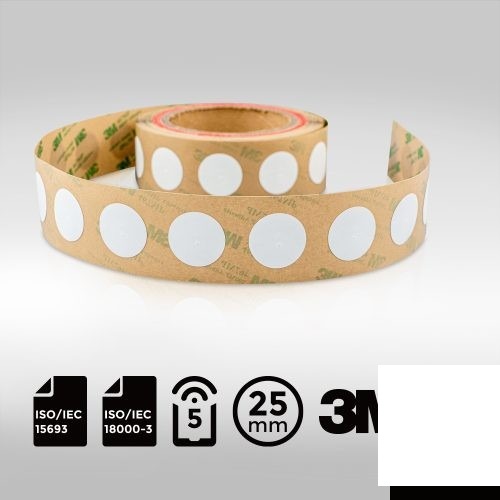
- 25×15 mm — glass ampoule (NXP UCODE 9 15 mm flag-label)
- 40×20 mm — 10-30 mL vial (Impinj M750 27 mm wrap or flag)
- 60×30 mm — 50-100 mL vial (Impinj M750 50 mm wrap-around)
- 15×70 mm — pre-filled syringe barrel wrap (Impinj M730 50 mm)
- 60×40 mm — IV bag 250-1000 mL (Impinj M730 70 mm)
- Substrate + adhesive
-
- Chemical-resistant synthetic — survives alcohol wipes + disinfectants
- USP <661.1> pharmaceutical-grade plastic packaging compatible
- Cold-chain adhesive — continuous 2-8 °C drug refrigerator
- Frozen-storage adhesive — intermittent −20 °C cycling
- Curved-glass-vial conformable formulation
- ADC integration partners
-
- BD Pyxis MedStation ES Gen7 RFID drawer module
- Omnicell XT series RFID-Ready pocket
- BD Rowa Vmax Restock Automation module
- Impinj Indy + Speedway reader families inside cabinets
- Per-cabinet-model test reports on request
- Pharmacy information system + eMAR integration
-
- Epic Willow (pharmacy) + Epic MAR (administration)
- Cerner PharmNet + PowerChart
- Meditech BPM + Expanse
- Wolters Kluwer Medi-Span drug database
- HL7 v2.x RAS (admin) + RGV (dispense) message flow
- FHIR R4 MedicationAdministration resource
- Controlled-substance + DEA framework
-
- DEA Form 222 paper + CSOS (Controlled Substance Ordering System) e-222
- Schedule II-V controlled-substance per-vial / per-syringe RFID audit
- Diversion-detection analytics: Bluesight + Omnicell Performance Center + Invistics ControlCheck
- Real-time anomaly flag: 4-6 weeks manual audit → <48 hours RFID detection
- State PDMPs consume patient-dispensed side via PIS
- Recall management workflow
-
- Query RFID system for recalled lot number
- Instant location list across all dispensing cabinets + pharmacy shelves
- 30-second task vs hours-long manual barcode scan
- FDA recall notification + remediation timeline compliance
- Patient-harm prevention through faster lot-isolation
- Application verticals
-
- Distribution-centre receiving — bulk RFID scan vs manual barcode
- Hospital pharmacy ADC restock (45-60 min → <10 min)
- Pharmacy shelf + refrigerator real-time RFID inventory
- Bedside 5-Rights verification via nurse smartphone NFC tap
- Controlled-substance access + dispense + waste audit
- Clinical-trial Investigational Medicinal Product (IMP) per ICH E6(R2) GCP
- Joint Commission + clinical safety framework
-
- Joint Commission NPSG.03.04.01 medication labelling + 5-Rights
- Five Rights: right patient + drug + dose + route + time
- Pre-RFID error rate: ~1 in 300 administrations
- 1.5 million preventable medication errors annually in US
- Post-RFID + eMAR integration: 85%+ bedside verification error reduction
- Standards + compliance
-
- US FDA DSCSA Title II (PL 113-54)
- GS1 General Specifications + EPC TDS SGTIN-96
- ISO/IEC 18000-63:2015 UHF RAIN RFID air interface
- USP <661.1> pharmaceutical-grade plastic packaging
- ICH E6(R2) GCP clinical-trial IMP handling
- Joint Commission NPSG.03.04.01 + medication-labelling standards
- FDA 21 CFR 211 Current Good Manufacturing Practice
- Procurement
-
- MOQ 10,000 labels (standard sizes, common chip)
- Lead time 15-20 business days
- Pre-encoded SGTIN-96 + UID-CSV inventory list
- Sample sets 100-200 labels for ADC qualification testing
- Per-cabinet-model qualification test report on request
- RoHS / REACH compliant materials
Challenges hospital pharmacies and pharma distributors face with medication serialisation
- FDA DSCSA unit-level serialisation enforcement requires every prescription drug package to carry a unique identifier traceable through the supply chain. But barcode scanning at receiving, dispensing and bedside creates labour-intensive bottlenecks that slow pharmacies processing 500-2,000 medication transactions per day.
- Automated dispensing cabinets (Pyxis, Omnicell) are restocked by manually scanning each vial barcode one at a time; a typical ADC restock of 200 items takes 45-60 minutes versus under 10 minutes with RFID bulk reading.
- Drug diversion of schedule II-V controlled substances costs US hospitals an estimated USD 72 billion annually in losses and liability. Manual access logs are easily falsified and provide no real-time detection capability.
- Recall management is a crisis response with barcodes — locating all units of a recalled lot number requires scanning every item across all dispensing cabinets and pharmacy shelves — a process that takes hours and risks delayed patient harm prevention.
- Point-of-care medication verification relies on nurses manually reading printed labels under poor lighting conditions; the 5 Rights check (right patient, drug, dose, route, time) fails in approximately 1 in 300 administrations, contributing to the 1.5 million preventable medication errors annually in the US.
How Proud Tek RFID medication labels solve serialisation and safety problems
Manual barcode scan + paper diversion log + visual 5-Rights check
- Barcode scan per vial: 200-vial ADC restock = 45-60 minutes
- Manual diversion audit: 4-6 weeks discovery time, paper-falsifiable logs
- Receive accuracy: 94-96% (barcode misread + counted-twice)
- Recall management: hours scanning every shelf + cabinet manually
- Bedside 5-Rights visual check: 1 in 300 administration error rate
UHF RFID bulk scan + RFID diversion analytics + NFC bedside tap-verify (this page)
- UHF RFID bulk scan: 200-vial ADC restock = <10 minutes (70-80% time saving)
- RFID diversion analytics (Bluesight / Omnicell PC / Invistics): <48 hour detection
- Receive accuracy: 99.8%+ via SGTIN-96 ASN-match
- Recall management: 30-second RFID lot-number query — instant location list
- NFC tap bedside verify: 85%+ administration error reduction with eMAR
- UHF RFID enables bulk reading of entire medication shipments at receiving — a cart of 500 vials scanned simultaneously in under 30 seconds, with each SGTIN-96 automatically matched against the DSCSA advance shipping notice.
- ADC restocking time drops from 45-60 minutes to under 10 minutes — place medications in the cabinet's RFID read zone, close the drawer, and all items are inventoried instantly without individual scanning.
- Controlled-substance tracking with RFID records every access, dispense and waste event with timestamp and user authentication — providing real-time anomaly detection that flags potential diversion within hours rather than weeks.
- Recall management becomes a 30-second task — query the RFID system for the recalled lot number and receive an instant list of every unit's current location across all dispensing points in the health system.
- NFC tap-to-verify at the bedside enables nurses to confirm drug identity, dose and patient match against the eMAR without error-prone visual label reading — using their existing smartphone.
Per-tap data published from a Proud Tek RFID medication vial label
- SGTIN-96 EPC: GTIN + unique serial encoded per GS1 TDS UHF RAIN binary spec.
- ASN-match: receive scan compares EPC against advance shipping notice → 99.8% accuracy.
- ADC restock: bulk-zone RFID read → cabinet inventory auto-incremented.
- Dispense audit: timestamp + user authentication + waste-event logged.
- Bedside verify: NFC tap → eMAR FHIR R4 MedicationAdministration record.
FDA DSCSA compliance
The Drug Supply Chain Security Act (DSCSA) requires unit-level serialised tracking of prescription drugs in the United States. By November 2024 (with enforcement discretion extensions), manufacturers, distributors and dispensers must be able to trace each individual drug package through the supply chain using a unique product identifier.
RFID enables automated, error-free capture of serialised data at every supply chain handoff — receiving at distribution centres, dispensing at hospital pharmacies and administration at the bedside. Unlike barcode scanning (which requires line-of-sight and individual scanning), RFID enables bulk reading of entire shipments and automated inventory of dispensing cabinets.
Applications
- Supply chain verification — scan incoming drug shipments at receiving to verify serialised data against advance shipping notices (ASNs).
- Automated dispensing cabinet (ADC) restocking — scan medications into Pyxis, Omnicell or BD Rowa cabinets with RFID instead of manual barcode scanning.
- Pharmacy inventory — real-time RFID inventory of pharmacy shelves and refrigerators enables automated reordering and expiry management.
- Point-of-care — nurse verifies correct medication at the bedside by scanning the vial RFID tag against the electronic medication administration record (eMAR).
- Controlled-substance tracking — detect drug diversion by monitoring every access, dispense and waste event for schedule II-V medications.
- Recall management — instantly locate all units of a recalled lot number across the entire health system.
Label configurations for different containers
| Container | Label size | Inlay | Application method |
|---|---|---|---|
| 10-30 mL vial | 40×20 mm | Impinj M750 (27 mm) | Wrap-around or flag label |
| 50-100 mL vial | 60×30 mm | Impinj M750 (50 mm) | Wrap-around |
| Glass ampoule | 25×15 mm | NXP UCODE 9 (15 mm) | Flag label (extends above ampoule) |
| Pre-filled syringe | 15×70 mm | Impinj M730 (50 mm) | Barrel wrap |
| IV bag (250-1000 mL) | 60×40 mm | Impinj M730 (70 mm) | Adhesive on bag surface |
RFID medication-vial timeline — from DSCSA enactment to bedside NFC verification
- 2003 — Joint Commission NPSG.03.04.01 medication labelling
Joint Commission publishes National Patient Safety Goal NPSG.03.04.01 — medication labelling + 5 Rights of safe administration becomes the patient-safety baseline that all hospital pharmacies operate against.
- 2013 — FDA Drug Supply Chain Security Act enacted (PL 113-54)
DSCSA establishes 10-year phased rollout for unit-level pharmaceutical serialisation in the US — manufacturers, distributors, dispensers must trace each individual drug package via unique product identifier.
- 2014-2018 — GS1 EPC TDS + UHF RAIN RFID maturity
GS1 publishes EPC Tag Data Standard SGTIN-96 binary encoding spec; ISO/IEC 18000-63:2015 UHF RAIN RFID air interface ratified; Impinj Monza + NXP UCODE chip families reach pharmaceutical-vial-compatible sensitivity.
- 2017-2019 — ADC vendor RFID modules launch
BD Pyxis MedStation ES Gen7 RFID drawer + Omnicell XT series RFID-Ready pocket + BD Rowa Vmax Restock Automation modules launch — ADC restock workflow shifts from manual barcode to RFID bulk-read.
- 2018 — NTAG 424 DNA + iOS 12 background NFC
NXP launches NTAG 424 DNA AES-128 SUN; Apple iOS 12 enables background NDEF reading — bedside NFC tap-to-verify with nurse smartphone becomes consumer-grade.
- 2020-2022 — Drug-diversion analytics platforms
Bluesight for Controlled Substances + Omnicell Performance Center + Invistics ControlCheck deploy peer-benchmark anomaly detection — RFID + analytics drops diversion-detection time from 4-6 weeks to <48 hours.
- Nov 2024 — DSCSA full enforcement
FDA DSCSA full enforcement begins November 2024 (after enforcement-discretion extensions). RFID becomes default mechanism for unit-level serialised compliance + ADC restock + bedside verification.
- 2026 — Today: RFID medication vial standard practice
Operating-playbook notes for hospital-pharmacy-adc, biopharma-distribution-centre, oncology-infusion-suite, surgical-anaesthesia-cart and clinical-trial-imp programmes converge on UHF SGTIN-96 + dual-frequency NFC bedside-verify + ADC RFID-module integration as the default architecture.
Useful next pages
Use these linked product, guide and comparison pages to keep the next click specific and practical.
Related pharma RFID products
Other RFID solutions for healthcare and pharma.
Chip-level technical reference
Deep-dive specifications and chip-family comparisons relevant to this SKU.
FAQ
Can the RFID label be read through glass vials?
Yes. UHF and NFC RFID signals pass through glass with minimal attenuation. Our labels are specifically designed for glass pharmaceutical containers. The label antenna is optimised for the curved surface and the liquid content of the vial (which can affect UHF tuning). Read range for a labelled vial is typically 0.3-1 m with a UHF handheld reader.
Does the label withstand refrigerated and frozen drug storage?
Yes. Our pharmaceutical labels use cold-storage adhesive rated for continuous exposure at 2-8 °C (standard drug refrigerator) and intermittent exposure to −20 °C (frozen medications). The label maintains adhesion and readability through repeated temperature cycling between cold storage and room temperature.
What data encoding standard do you use?
We encode per GS1 standards: SGTIN-96 format containing the GTIN (Global Trade Item Number) and a unique serial number. This is the data structure required by FDA DSCSA. We can also encode GS1 Digital Link URIs for NFC labels that resolve to product information pages when tapped with a smartphone.
How does RFID medication labelling integrate with Pyxis / Omnicell / BD Rowa automated dispensing cabinets?
All three major ADC vendors support RFID-enabled restocking workflows through their current hardware generations — BD Pyxis MedStation ES with the Gen7 RFID drawer module, Omnicell XT series with the RFID-Ready pocket and BD Rowa Vmax with the Restock Automation module. Integration happens at two levels. At the device level, the RFID reader in the restock station captures the SGTIN-96 EPC for every vial placed in the drawer and automatically increments the cabinet's inventory, replacing the tech's barcode-scan-and-count step. At the enterprise level, HL7 v2.x RAS (pharmacy administration) and RGV (dispense) messages flow between the ADC, the pharmacy information system (Epic Willow, Cerner PharmNet, Meditech BPM, Wolters Kluwer Medi-Span) and the hospital's DSCSA traceability repository. ProudTek labels are qualified against the Impinj Indy and Speedway reader families used inside these cabinets; we provide per-cabinet-model test reports on request.
How does RFID-based controlled-substance tracking interact with the DEA CSOS e-222 order system and state PDMPs?
RFID tracking operates at the clinical-dispensing layer and is complementary to the DEA regulatory layer, not a replacement. The DEA Form 222 (paper) and CSOS (Controlled Substance Ordering System) electronic 222 ordering process governs distribution of schedule II substances from manufacturer or distributor to the registered DEA purchaser (the hospital). Once the controlled substances are received at the pharmacy, the RFID layer tracks per-vial / per-syringe events — receive, stock to ADC, dispense to patient, administer, waste, count discrepancy — with timestamps and user authentication. That dispensing-layer data feeds the hospital's drug-diversion detection analytics (Bluesight for Controlled Substances, Omnicell Performance Center, Invistics ControlCheck) which compare actual access / waste patterns against peer-benchmark norms and flag anomalies. State Prescription Drug Monitoring Programs (PDMPs) consume the patient-dispensed side through the pharmacy information system, not directly from the RFID layer. RFID's role is to make the per-unit audit trail that feeds all these regulatory and detection systems automatic and tamper-evident instead of dependent on manual documentation.
Sources & references
Primary standards, OEM datasheets and regulatory documents cited by this article. All URLs were verified on the access date shown below.
- Drug Supply Chain Security Act (DSCSA, PL 113-54) — FDA Title II unit-level serialization framework
DSCSA Title II — unit-level serialised tracking of prescription drugs. Full enforcement Nov 2024 after enforcement-discretion extensions.
- GS1 General Specifications — SGTIN-96 EPC encoding for serialised pharmaceutical product identifiers
GS1 General Specifications — SGTIN-96 (Serialised Global Trade Item Number) EPC binary encoding mandated by FDA DSCSA.
- GS1 EPC Tag Data Standard (TDS) — SGTIN-96 binary encoding specification for UHF RAIN tags used in DSCSA pharmaceutical labelling
EPC TDS 2.0 — binary encoding specification for SGTIN-96 on UHF RAIN tags. Reference standard for DSCSA-compliant RFID medication labels.
- ISO/IEC 18000-63:2015 — UHF RAIN RFID air interface standard (the chip-level standard underlying RFID medication labels)
UHF RAIN RFID 860-960 MHz air-interface standard — basis for Impinj Monza + NXP UCODE chip families used in pharmaceutical labels.
- Impinj M700 series product page and datasheet — high-sensitivity small-antenna RAIN RFID chip family used in vial / ampoule / syringe labels
Impinj M700 series (M730 / M750 Monza R6-P) — high-sensitivity chip qualified for small-antenna pharmaceutical-vial / ampoule / syringe labels.
- NXP UCODE 9 product page — alternative high-sensitivity RAIN RFID chip qualified for small-antenna pharmaceutical labels
NXP UCODE 9 — alternative high-sensitivity RAIN chip; 15 mm flag-label antenna for glass-ampoule deployment.
- DEA Controlled Substance Ordering System (CSOS) — electronic DEA Form 222 framework for Schedule II controlled-substance ordering
DEA CSOS e-222 — electronic ordering framework for Schedule II controlled substances. RFID dispensing-layer audit complementary to CSOS regulatory layer.
- Joint Commission National Patient Safety Goals — goal NPSG.03.04.01 on medication labelling and the 'five rights' of safe medication administration
NPSG.03.04.01 + 5 Rights (right patient + drug + dose + route + time) — patient-safety baseline addressed by NFC bedside-verify integration.
- ICH E6(R2) Good Clinical Practice — Investigational Medicinal Product (IMP) handling
ICH E6(R2) GCP — IMP handling framework for clinical trials. RFID medication-vial labels support IMP chain-of-custody + drug-accountability requirements.
- USP <661.1> — Plastic Materials of Construction (pharmaceutical packaging)
USP <661.1> pharmaceutical-grade plastic packaging compatibility — substrate qualification requirement for RFID medication-vial label face stock.
Proud Tek is a Shenzhen-based RFID & NFC manufacturer supplying hotel chains, transit operators, event venues and retail brands worldwide. Every order includes free samples, RF testing and dedicated project support.
Get a Quick Quote
Tell us about your project and we'll respond within one business day. Fields marked (asterisk) are required.