
Payment NFC
NFC Tap-to-Pay Sticker
Apple Pay + Google Pay

Quick answer
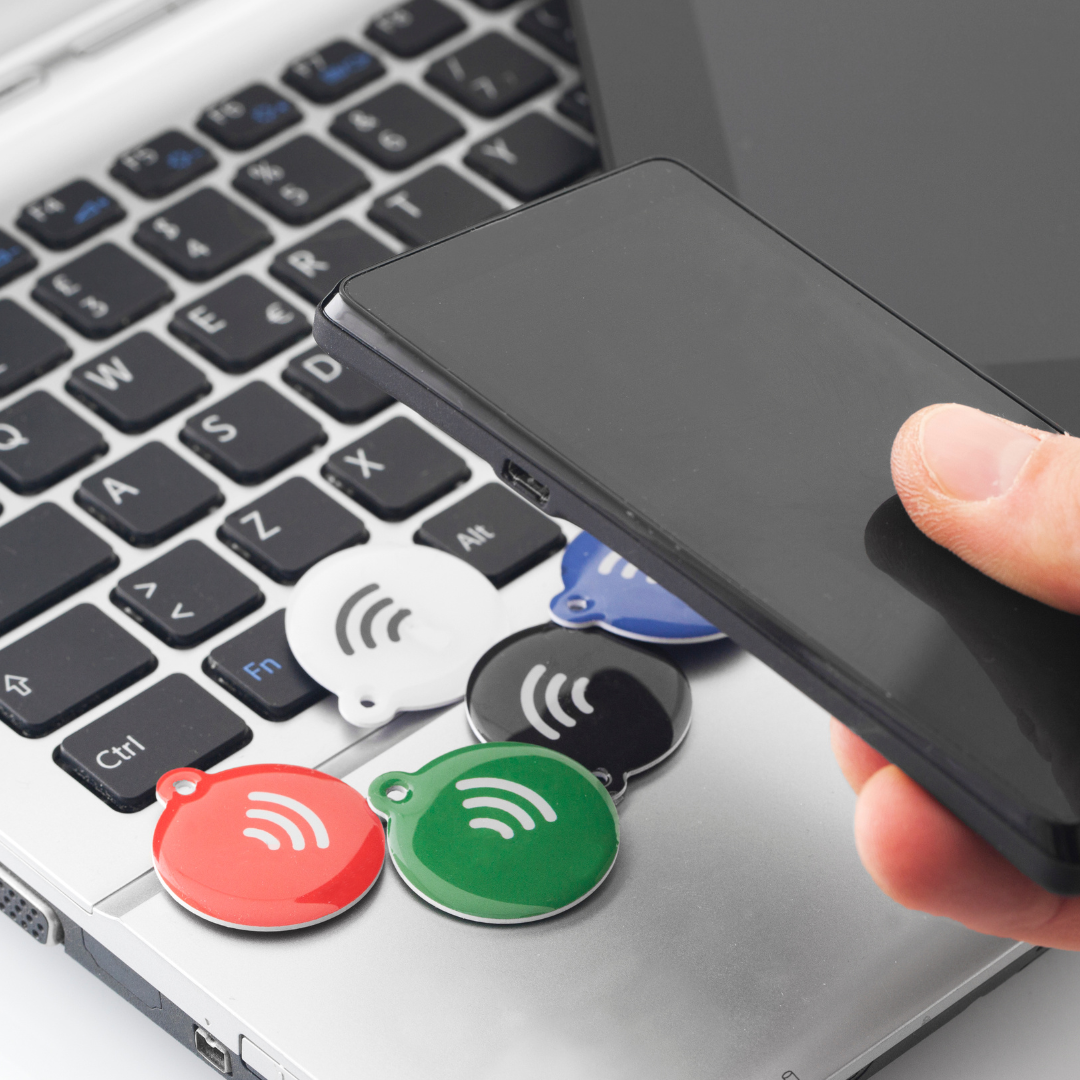
NFC tap-to-pay stickers turn any surface into a contactless payment acceptance point — micro-merchants, vending operators, transit systems, event organisers and tip-jar deployments accept NFC mobile-wallet payments (Apple Pay, Google Pay, Samsung Pay) without traditional POS hardware. The adhesive sticker carries a passive NTAG213 / NTAG216 / NTAG 424 DNA chip that triggers a hosted checkout URL via NDEF URL launch when tapped. PSD2 SCA-compliant via mobile-wallet device-biometric + device-binding flow. PCI DSS v4.0 out-of-scope at sticker layer (only URL on chip, no PAN). Compatible with Stripe / PayPal / Square / Adyen / Razorpay hosted checkout and Open Banking PIS / Pix / UPI / Bizum A2A rails.
- Where brand-standard finish matters, zero hardware — accept contactless payments by sticking a tag on any surface — no POS terminal, card reader or power source required.
- Universal wallet support: works with Apple Pay, Google Pay, Samsung Pay and all NFC-enabled mobile wallets through standard NDEF URL launch + W3C Payment Request API.
- Instant deployment: peel-and-stick installation on counters, tables, menus, vending machines and event booths with zero setup time + PCI DSS out-of-scope at sticker layer.
Used in these industries
Deployments where this product is referenced on our industry landing pages.

At a glance
Use these short answers to decide whether this page matches the project before moving into the detail.
Chip silicon options
NXP NTAG213 (144 B) — entry-tier static-URL low-risk merchant (~USD 0.08/unit) NXP NTAG216 (888 B) — extended payload (multi-link checkout / vCard)
Form factors + sizes
Ø22 mm round — countertop / tip jar / table Ø30 mm round — standard balanced size
Next step
Ready to move forward? Start your inquiry to get specific answers for this project.
Request quote and samples- Substrate + adhesive
-
- PET face stock 75 µm with PSA — countertop standard
- Durable PET overlay — scratch / spill / cleaning-agent resistant
- Acrylic permanent PSA (3M 467MP / 9472LE)
- Operating temperature −25 °C to +85 °C — outdoor + transit shelter compatible
- FDA 21 CFR 175.105 indirect-food-contact PSA option
- NDEF + payment-launch architecture
-
- NDEF URI Record (https:// required for iOS / Android default-handler)
- Hosted checkout URL — Stripe / PayPal / Square / Adyen / Razorpay
- Static URL — fixed amount / variable amount / tipping configurable
- Dynamic URL with NTAG 424 DNA SUN — AES-128 MAC per tap (NXP AN12196)
- Universal Links + Android App Links — deep-link to wallet app where installed
- Mobile-wallet platform support
-
- Apple Pay (iOS 14+ Core NFC background NDEF launch)
- Google Pay (Android 4.0+ NFC System Service NDEF dispatch)
- Samsung Pay + Garmin Pay + Fitbit Pay
- W3C Payment Request API — native wallet button rendering
- Wallet detection + locale-aware redirect for international deployments
- Regional payment-rail support
-
- US/EU — Apple Pay / Google Pay / Samsung Pay dominant
- China — Alipay / WeChat Pay (QR fallback alongside NFC)
- Japan — LINE Pay / PayPay
- Korea — KakaoPay
- SE Asia — GrabPay
- A2A rails — UK Open Banking PIS / Brazil Pix / India UPI / Spain Bizum
- Regulatory framework
-
- EU PSD2 (Directive 2015/2366) + RTS-SCA (Reg 2018/389) — 2-of-3 factor authentication
- PSD2 SCA satisfied via mobile-wallet device-biometric (inherence) + device-binding (possession)
- PCI DSS v4.0 — sticker out-of-scope (URL only, no cardholder data)
- EMVCo Contactless Books A-D — sticker sits OUTSIDE EMVCo terminal cert (CNP web-checkout)
- US CFPB Reg E (12 CFR Part 1005) — chargeback rights apply
- UK FCA CONC 2.1 + Consumer Credit Act §75 — chargeback / s.75 rights
- Anti-fraud architecture
-
- Static URL: phishable — bad actor can peel + replace sticker (visible inspection mitigation)
- NTAG 424 DNA SUN dynamic URL: AES-128 MAC per tap — clone + replace defeated server-side
- Counter-monotonicity check: replay attacks defeated
- Velocity / geo-fencing: Stripe Radar / Adyen RevenueProtect / PayPal Advanced Fraud
- 3-D Secure 2 step-up trigger on abnormal tap pattern
- Bridge-antenna tamper variant — physical removal-attempt sets CTTES register
- Hosted checkout integration
-
- Stripe Checkout + Stripe Payment Element + Stripe Radar fraud
- PayPal Checkout + Pay Later + One-Touch
- Square Online Checkout + Square Cash App Pay
- Adyen Checkout + RevenueProtect
- Razorpay + Mercado Pago for emerging markets
- Custom-hosted checkout with W3C Payment Request API
- Customer UX flow
-
- Tap NFC sticker on payment surface (1 sec)
- Hosted checkout page launches in default browser (no app required)
- Apple Pay / Google Pay button renders natively from Payment Request API
- Customer authorises with Face ID / Touch ID / fingerprint / PIN (<5 sec)
- Confirmation page + receipt — total time 5-10 seconds
- Manual card-entry fallback with 3DS2 SCA challenge
- Application verticals
-
- Micro-merchants — market stall / food truck / street performer / pop-up shop
- Tip jars + round-up donations — coffee shop / barber / valet
- Vending machines + parking meters — unattended retail
- Event vendor booths — festival / conference / trade show
- Hotel self-check-in + room-service unattended kiosks
- Art gallery + museum gift-shop purchase tags
- Procurement
-
- MOQ 100 (NTAG213 standard size), 500 custom-print
- MOQ 1,000 provisioned (NTAG 424 DNA cryptographic anti-skimming)
- Lead time 7-12 business days (NTAG21x), 15-20 business days (NTAG 424 DNA)
- Pre-encoded with merchant payment-page URL + UTM tags
- Multi-tier mix supported — NTAG213 low-ticket / NTAG 424 DNA fixed-price
- RoHS / REACH compliant materials
Payment acceptance challenges for micro-merchants and pop-up businesses
- Traditional POS terminals cost USD 200-800 upfront plus USD 30-50 monthly fees — prohibitively expensive for market stall vendors, food trucks, street performers, pop-up shops and single-operator micro-businesses.
- Mobile card readers (Square, SumUp) require Bluetooth pairing, battery charging and a smartphone nearby — introducing failure points at the busiest moments and creating checkout friction that loses impulse purchases.
- Cash-only businesses lose 30-50% of potential sales in increasingly cashless economies. In markets where 60-80% of consumers prefer digital payments, refusing cards means turning away customers.
- QR-code payment systems require the customer to open a camera app, scan, navigate to a URL, enter an amount and confirm — a 5-7 step process that takes 30-60 seconds and deters quick transactions.
- Event organisers managing 50-200 vendor booths cannot deploy POS hardware to every booth. Vendors default to cash, creating revenue leakage, slow transaction times and theft exposure.
How Proud Tek NFC tap-to-pay stickers enable frictionless payment acceptance
- NTAG213 or NTAG216 chip stores an NDEF URL record that launches a payment page on the customer's phone. The customer taps, sees the payment amount and confirms with Face ID, Touch ID or PIN in under 5 seconds.
- No hardware, no battery, no Bluetooth, no Wi-Fi. The NFC sticker is a passive tag that draws power from the tapping phone, operates indefinitely and never needs charging or software updates.
- Custom-branded stickers with merchant name, logo, QR code fallback and 'Tap to Pay' instruction provide a professional payment acceptance experience on any surface — counter, table, menu, machine or booth.
- Dynamic payment links support variable amounts (customer enters amount), fixed amounts (preset prices) and tipping. Configurable per merchant through a web dashboard without replacing the physical sticker.
- Works with all major payment processors and gateways (Stripe, PayPal, Square Online, Adyen). The NFC tag launches a hosted payment page; no custom integration or app development required.
Per-tap data published from a Proud Tek NFC tap-to-pay sticker
- Sticker NDEF: https:// URI Record only — no PAN, no cardholder data, PCI out-of-scope.
- iOS Core NFC: background NDEF read on iPhone XS+ + iOS 14+ — phone unlocked + screen on.
- Android NFC: NDEF_DISCOVERED intent dispatch on tap — auto-launch default browser.
- Wallet button: W3C Payment Request API renders Apple Pay / Google Pay natively.
- NTAG 424 DNA SUN: AES-128 per-tap MAC defeats clone-and-replace fraud server-side.
EMVCo contactless, PSD2 Strong Customer Authentication and the mobile-wallet payment rail
- EMVCo (owned by American Express, Discover, JCB, Mastercard, UnionPay and Visa) publishes the EMV Contactless Specifications for Payment Systems (books A-D, currently v2.11) that define the card-present tap flow. NFC tap-to-pay stickers deliberately sit outside this rail — they are card-not-present (CNP) web-checkout flows triggered by NFC URL launch, so they don't incur the EMVCo terminal certification burden.
- EU Revised Payment Services Directive (PSD2, Directive 2015/2366) and its Regulatory Technical Standards on Strong Customer Authentication (Commission Delegated Regulation 2018/389) require 2-of-3 factor authentication (knowledge, possession, inherence) for most electronic payments. Mobile-wallet CNP flows satisfy SCA through the customer's device biometric (inherence) + device-binding (possession), which is why Apple Pay / Google Pay on a tap-launched payment page flows through without friction, while a bare card-entry page would require a 3-D Secure challenge.
- Payment Card Industry Data Security Standard (PCI DSS v4.0) scope is kept minimal because the NFC tag itself carries only a URL — no PAN, no cardholder data, no payment secrets. The merchant's sticker is PCI-out-of-scope; only the hosted checkout page (provided by Stripe, Adyen, PayPal, etc.) sits inside the PCI boundary, and those providers are Level 1 PCI DSS certified service providers.
- US CFPB Regulation E (12 CFR Part 1005) and UK FCA CONC 2.1 treat tap-launched web payments as standard e-commerce transactions — chargeback rights under Reg E §1005.11 (consumer liability) and UK Consumer Credit Act §75 apply to the customer, and interchange (0.05-2.5% depending on scheme + card type) flows through the acquirer normally.
- Decoupled debit / account-to-account rails — Open Banking Payment Initiation Service (UK FCA + EU PSD2), Pix (Brazil, Banco Central do Brasil), UPI (India, NPCI), Bizum (Spain) — are all addressable via the same NFC-URL launch pattern, which makes the sticker medium-agnostic: one tag can switch between card and A2A payment methods by updating the hosted checkout configuration server-side.
Mobile-wallet UX, static-vs-dynamic NDEF records and the anti-skimming architecture
- NDEF URL record format (NFC Forum RTD 1.0 + URI RTD 1.0) embeds a payment-page URL that Apple's CoreNFC background tag reading (iPhone XS and later, iOS 14+) and Android's NDEF_DISCOVERED intent (Android 4.0+, NFC System-Service) launch in-browser without app-install. Critical: iOS requires the NDEF URL to be https:// — http:// URLs are silently ignored, and Apple's Tag Reader Mode requires the device to be unlocked.
- Static NDEF URLs (hard-coded merchant + amount in URL query string) are cheap but phishable — a bad actor can peel and replace the sticker. Dynamic URLs with NTAG 424 DNA Secure Unique NFC (SUN) per NXP AN12196 sign each tap with an AES-128 MAC that the checkout page validates, preventing tag cloning and replaced-sticker fraud. Trade-off: NTAG213 unit cost ~USD 0.08; NTAG 424 DNA ~USD 0.40-0.60.
- Tap-and-pay UX best practice: the hosted checkout page should show merchant name + amount on a single above-the-fold screen, with the wallet Pay button as the dominant CTA. Stripe Checkout's Apple Pay / Google Pay buttons render natively from the Payment Request API (W3C draft) when the device has a provisioned wallet credential, skipping manual card entry.
- Velocity / geo-fencing fraud controls — Stripe Radar, Adyen RevenueProtect, PayPal Advanced Fraud Protection — key on device fingerprint, velocity of tags read from the same IP, and tap-to-confirm timing. Abnormal tap patterns (e.g., 50 tags from the same IP in 60 seconds) trigger 3-D Secure step-up or decline.
- Regional wallet coverage matters: Apple Pay / Google Pay dominate US / EU; Alipay / WeChat Pay dominate China and require QR-code fallback alongside NFC (Chinese Apple Pay works but is not dominant); LINE Pay / PayPay in Japan; KakaoPay in Korea; GrabPay in SE Asia. A well-designed sticker campaign uses a wallet-detection redirect so the right wallet is served per customer locale.
NFC tap-to-pay timeline — from EMVCo contactless to wallet-launched URL flow
- 2007 — EMVCo Contactless Specifications Books A-D published
EMVCo (American Express + Discover + JCB + Mastercard + UnionPay + Visa) publishes EMV Contactless Specifications — defines the card-present tap flow on POS terminals. Tap-to-pay stickers sit OUTSIDE this rail (CNP web-checkout).
- 2014 — Apple Pay launches with iPhone 6
Apple launches Apple Pay on iPhone 6 — mobile wallet credential + Touch ID biometric authorisation. PSD2 SCA-compliant flow becomes consumer-grade.
- 2015-2016 — Google Pay (Android Pay) + Samsung Pay launch
Google Pay (initially Android Pay) and Samsung Pay launch — universal wallet support across Android ecosystem. W3C Payment Request API draft begins.
- 2018 — EU PSD2 SCA + Apple iOS 12 background NFC
EU PSD2 SCA RTS (Reg 2018/389) takes effect — 2-of-3 factor authentication for electronic payments. Apple iOS 12 enables background NDEF reading on iPhone XS / XR — tap-tag-to-URL works without app for the first time.
- 2019-2021 — COVID-19 contactless inflection + tip-jar NFC explosion
COVID-19 pandemic accelerates contactless payment adoption — tip jars, food trucks, market stalls deploy NFC tap-to-pay stickers en masse. Stripe Checkout / Square Online Checkout / PayPal hosted-checkout integrations become standard.
- 2022-2023 — A2A rails + Open Banking + Pix + UPI scale
Open Banking PIS (UK FCA + EU PSD2), Pix (Brazil), UPI (India), Bizum (Spain) all addressable via same NFC-URL launch pattern. NFC sticker becomes medium-agnostic between card + A2A rails.
- 2024 — PCI DSS v4.0 effective + W3C Payment Request API
PCI DSS v4.0 effective — sticker out-of-scope confirmed (URL only, no PAN). W3C Payment Request API enables native wallet button rendering. NTAG 424 DNA SUN cryptographic anti-skimming variant matures.
- 2026 — Today: NFC tap-to-pay sticker standard payment-acceptance
Cross-buyer reference experience on micro-merchant-pop-up, tip-jar-coffee-shop, vending-machine-unattended, event-vendor-booth, hotel-self-check-in and unattended-kiosk programmes shows converge on NTAG213 / NTAG 424 DNA + Stripe / PayPal / Square hosted checkout + W3C Payment Request API + PSD2 SCA wallet-biometric flow as the default architecture.
Useful next pages
Use these linked product, guide and comparison pages to keep the next click specific and practical.
Related NFC products
Other NFC sticker solutions for engagement and payments.
FAQ
Does the customer need to download an app to pay?
No. The NFC sticker launches a mobile web payment page directly in the customer's default browser when tapped. The customer authorises the payment with their phone's built-in authentication (Face ID, Touch ID, fingerprint or PIN). No app download, no account creation and no QR code scanning required.
What payment processors are compatible?
The NFC tag launches a URL, so it works with any payment processor that provides a hosted checkout page — Stripe, PayPal, Square Online, Adyen, Razorpay, Mercado Pago and hundreds of others. We can pre-configure the NFC tag URL for your specific payment processor during encoding.
How durable is the sticker in a retail environment?
The sticker uses a durable PET overlay that resists scratches, spills, cleaning agents and UV exposure. In typical countertop use, the sticker lasts 2-3 years before needing replacement. The NFC chip itself has no battery and retains its programming indefinitely. For high-traffic surfaces, we offer a clear acrylic dome overlay that extends physical life to 5+ years.
How does the sticker comply with PSD2 Strong Customer Authentication in Europe?
The NFC sticker itself is not a regulated payment instrument — it's a URL dispatcher. The actual SCA compliance happens on the hosted checkout page provided by your payment processor (Stripe, Adyen, PayPal, etc.), which is a PSD2-licensed Payment Service Provider. When the customer taps and lands on the checkout page, the Apple Pay / Google Pay flow satisfies SCA through device biometric (inherence factor) + device-bound wallet credential (possession factor), passing the 2-of-3 requirement in Commission Delegated Regulation 2018/389 without triggering a 3-D Secure challenge. For fall-through to manual card entry, the PSP applies 3DS2 / EMV 3-D Secure to complete SCA. The sticker is PCI-out-of-scope because it never carries cardholder data.
Should I use a static NDEF URL or NTAG 424 DNA dynamic SUN for tap-to-pay?
Depends on the fraud profile and unit economics. Static NDEF URLs (NTAG213 ~USD 0.08 / unit) work well for low-risk merchant environments — coffee shops, tip jars, parking meters — where a cloned or swapped sticker would yield minimal fraud value and the merchant can visually inspect the sticker daily. For higher-value environments — hotel self-check-in, unattended kiosks, art-gallery purchase tags — the NTAG 424 DNA with Secure Unique NFC (SUN) per NXP AN12196 adds an AES-128 MAC to every tap, so a cloned or peeled-and-replaced sticker fails server-side validation within milliseconds. Unit cost rises to ~USD 0.40-0.60, but chargeback exposure drops materially. We can mix both tiers in a single merchant deployment — NTAG213 for low-ticket tip / round-up flows, NTAG 424 DNA for fixed-price purchase stickers.
Sources & references
Primary standards, OEM datasheets and regulatory documents cited by this article. All URLs were verified on the access date shown below.
- EMV Contactless Specifications for Payment Systems (Books A-D) v2.11
EMV Contactless Books A-D — defines card-present tap flow on POS terminals. NFC tap-to-pay stickers sit OUTSIDE this rail (CNP web-checkout) — no terminal certification burden.
- Directive (EU) 2015/2366 (PSD2) on payment services in the internal market
EU Revised Payment Services Directive — Strong Customer Authentication framework + Open Banking PIS / AISP licensing.
- Commission Delegated Regulation (EU) 2018/389 — Regulatory Technical Standards on Strong Customer Authentication
RTS-SCA — 2-of-3 factor authentication (knowledge / possession / inherence) for electronic payments. Mobile-wallet device-biometric + device-binding satisfies SCA.
- Payment Card Industry Data Security Standard (PCI DSS) v4.0
PCI DSS v4.0 — sticker out-of-scope (URL only, no cardholder data). Hosted checkout page (Stripe / Adyen / PayPal) sits inside PCI boundary as Level 1 service provider.
- NFC Forum — NFC Data Exchange Format (NDEF) Technical Specification v1.0 + URI Record Type Definition
NDEF data-exchange format + URI RTD — basis for hosted-checkout URL encoding on NFC tap-to-pay sticker chips.
- NXP Semiconductors AN12196 — NTAG 424 DNA Features and Hints (Secure Unique NFC)
NTAG 424 DNA SUN cryptographic per-tap AES-128 MAC + monotonic counter — defeats clone + replace + replay attacks server-side.
Proud Tek is a Shenzhen-based RFID & NFC manufacturer supplying hotel chains, transit operators, event venues and retail brands worldwide. Every order includes free samples, RF testing and dedicated project support.
Get a Quick Quote
Tell us about your project and we'll respond within one business day. Fields marked (asterisk) are required.