
Industrial RFID
RFID Laundry Tags
Complete Buyer's Guide
Quick answer
The linen that never comes back is the whole reason this market exists: a procurement-focused guide to RFID laundry tag types, frequency selection, wash-cycle durability and ROI calculation for commercial and industrial laundry operations.
- Tag form factor must match the textile type, wash temperature and chemical exposure in the specific laundry process.
- UHF tags offer bulk read speed at the tunnel reader; HF tags provide individual garment tracking at shorter range.
- ROI breakeven on RFID laundry programs typically occurs within 6-12 months through loss reduction and labour savings.
At a glance
Use these short answers to decide whether this page matches the project before moving into the detail.
Key takeaway
Tag form factor must match the textile type, wash temperature and chemical exposure in the specific laundry process.
Why RFID for commercial laundry
Every commercial laundry manager has, at some point, lost an argument with a spreadsheet: the count of clean linen that left never quite matches the count that comes bac...
Next step
Ready to move forward? Start your inquiry to get specific answers for this project.
Get laundry tag samplesWhy RFID for commercial laundry
Every commercial laundry manager has, at some point, lost an argument with a spreadsheet: the count of clean linen that left never quite matches the count that comes back, and nobody in the building can say where the missing pieces went — guest bags, mop closets, the loading dock, a competitor's shelf. Without per-item tracking, 'where did the linen go?' is unanswerable, and so is 'how do we stop it?' Closing that gap is what RFID gets bought to do. Commercial laundries processing hotel linen, hospital scrubs, uniforms or industrial workwear manage tens of thousands of textile items daily. Manual counting is slow, error-prone and expensive. RFID replaces visual inspection and barcode scanning with automated bulk reading.
An RFID-tagged textile passes through a tunnel reader or over a table antenna and is identified without line-of-sight, even when items are bundled in bags or stacked on carts. This shifts the tracking bottleneck from manual handling to data processing, where software is fast and cheap.
- Automated piece counts at soil-sort, wash, finish and dispatch stages eliminate manual tally errors.
- Real-time inventory visibility reduces linen loss rates from the industry average of 10-15 % to below 5 %.
- Labour savings at sort and count stations typically cover the tag investment within two wash-cycle rotations.
- Garment lifecycle data (wash count per item) enables condition-based replacement instead of calendar-based purchasing.
- Customer-level tracking for rental laundries ensures correct allocation and simplifies invoicing.
Which tag type should you choose — PPS, silicone, or textile?
Three physical form factors dominate the RFID laundry tag market. Each is designed to survive repeated industrial wash, dry and press cycles, but they differ in attachment method, size and textile compatibility.
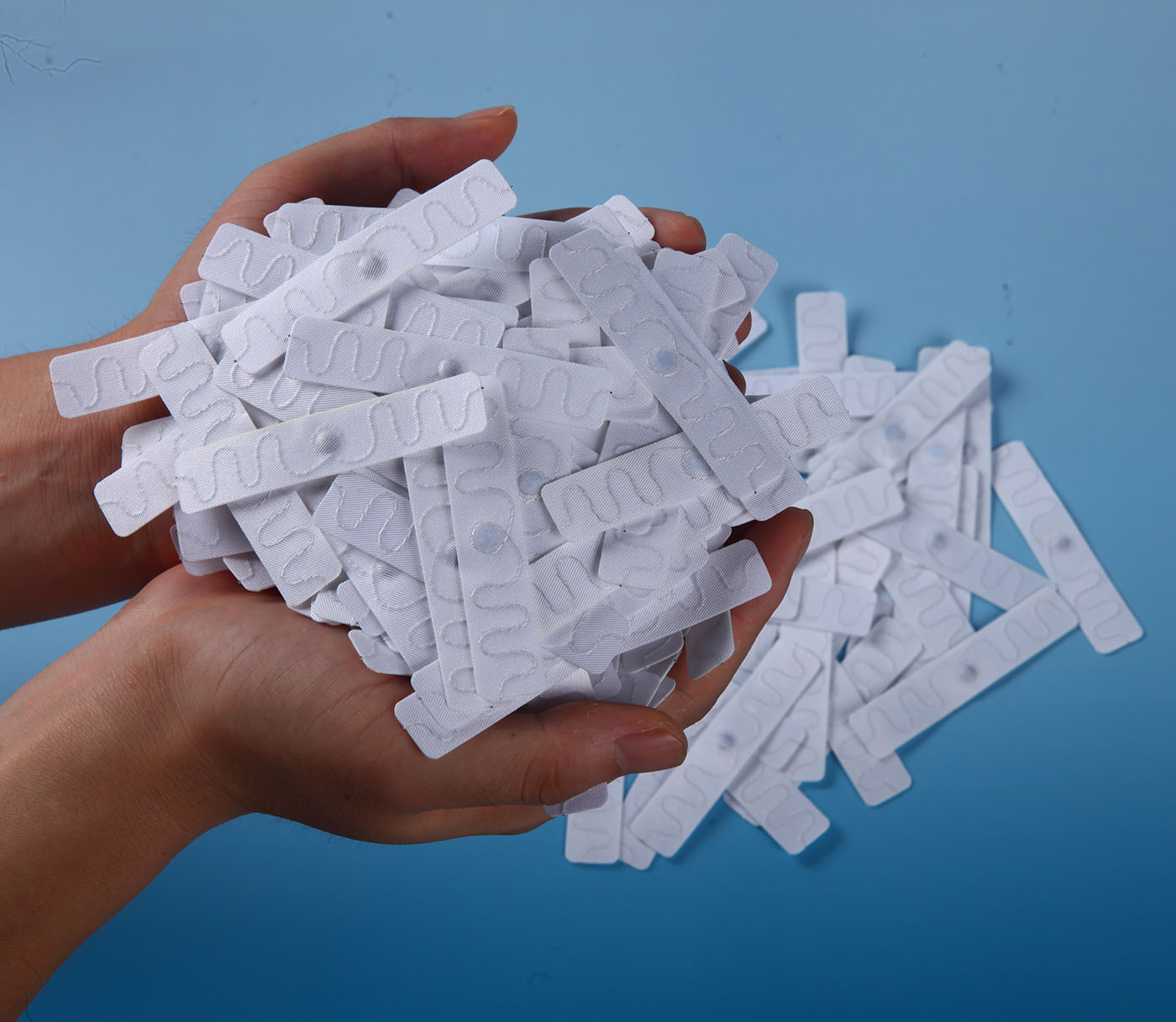
- PPS (polyphenylene sulfide) tags. Small, rigid button or disc format. Heat-sealed or sewn into garments. Excellent chemical resistance and the highest operating temperature tolerance (up to 200 degrees Celsius). Best for uniforms, scrubs and workwear.
- Silicone tags: Flexible, encapsulated in medical-grade silicone. Typically sewn into seams or heat-pressed onto flat linen. Good bend tolerance and comfortable against skin. Preferred for hotel towels, bathrobes and patient gowns.
- Textile (fabric) tags: Woven or non-woven label format with embedded RFID inlay. Sewn in like a standard care label. Thinnest and most flexible option. Suitable for lightweight garments where a rigid tag would be noticeable.
| Property | PPS | Silicone | Textile |
|---|---|---|---|
| Max wash temperature | 200 °C | 180 °C | 60-90 °C |
| Wash cycle endurance | 200+ cycles | 150-200 cycles | 50-100 cycles |
| Typical dimensions | 16-22 mm diameter | 45 × 15 × 3 mm | 50 × 15 × 0.8 mm |
| Attachment method | Heat-seal, sew-in, or rivet | Sew-in or heat-press | Sew-in (like care label) |
| Chemical resistance | Excellent (acids, bleach) | Very good | Moderate |
| Best textile match | Uniforms, workwear, scrubs | Towels, robes, patient gowns | Lightweight garments, linens |
| Unit cost (MOQ 10K) | $0.15 – $0.30 | $0.20 – $0.40 | $0.10 – $0.20 |
What's the difference between frequency choice: HF and UHF?
RFID laundry tags are available in HF (13.56 MHz) and UHF (860-960 MHz). The frequency determines read range, bulk-read capability and infrastructure cost.
- HF laundry tags read at 5-15 cm and are ideal for individual garment check-in and check-out at point-of-use stations (e.g. nurse uniform dispensers).
- UHF laundry tags read at 1-8 metres and support bulk scanning of 50-200 items per second through tunnel readers or portal gates.
- Most high-volume commercial laundries choose UHF for throughput reasons. HF is preferred when individual-item accountability matters more than bulk speed.
- UHF tags use EPC Gen2 (ISO 18000-63) air interface and are compatible with Impinj, Zebra and Alien fixed readers.
- Dual-frequency tags exist but are rarely cost-justified for laundry applications.
How do wash cycle durability and testing work?
The defining specification for any RFID laundry tag is how many industrial wash, dry and press cycles it survives with full read reliability. Procurement teams should request certified endurance data, not just marketing claims.
- Industrial wash cycles typically run at 60-85 degrees Celsius with alkaline detergent and chlorine bleach for healthcare or hospitality linen.
- PPS tags from leading manufacturers are rated for 200+ cycles at 75 degrees Celsius with standard chemistry. Request test reports to ISO 15693 or RAIN RFID standards.
- Tunnel dryers add mechanical stress and temperatures up to 180 degrees Celsius. Tag survival through the full wash-dry-press sequence matters more than wash-only ratings.
- Flatwork ironers (calender presses) apply direct heat at 160-180 degrees Celsius and high compression. Tags on flat linen (sheets, tablecloths) must withstand this step.
- Request a pilot batch of 100-200 tags, attach them to representative textiles and run them through 20 full cycles before committing to production volumes.
How do you handle ROI calculation for RFID laundry programs?
Building a business case for RFID laundry tracking requires quantifying three cost areas: linen loss reduction, labour savings and lifecycle extension.
- Linen loss: If a 500-room hotel processes 20,000 items per day and loses 12 % annually, RFID tracking that reduces loss to 3 % saves the replacement cost of roughly 1,800 items per year.
- Labour: Eliminating manual counting at four sort stations, each staffed for 6 hours daily, recovers approximately 8,700 labour hours per year.
- Lifecycle extension: Condition-based retirement (replacing items at 150 wash cycles instead of a blanket 12-month calendar) extends average garment life by 20-30 %.
- Tag cost is the main upfront investment: at $0.20 per tag and 20,000 items, the initial tagging outlay is $4,000. Infrastructure (readers, antennas, software) adds $10,000-$30,000 depending on site complexity.
- Most commercial laundry RFID projects report full payback in 6-12 months and a 3-year ROI of 200-400 %.
Tunnel reader and sortation infrastructure — choosing the read-point hardware that makes RFID work
An RFID laundry deployment is 30% tag and 70% read infrastructure. The five hardware components below define throughput, accuracy and reliability — getting them wrong renders even the best tags useless.
- Tunnel readers (Times-7 A5020 / A6033, Impinj XPortal / xSpan, Datalogic Memor / Skorpio gateway) — read 200-500+ items per second through the tunnel as linen carts pass at 0.5-1.2 m/s. Read-rate accuracy 99.5%+ at typical hospital and hotel cart density. Cost $4K-$12K per tunnel; calibration takes 1-3 days; cabling and antenna mounting $2K-$5K extra.
- Portal readers (Impinj R720 + Times-7 Slimline antennas, Zebra FX9600 + AN720 antennas, Nordic ID Sampo S2 + tray antennas) — 2-4 antenna gantries at facility entry / exit, sort-line, dispatch dock. Read 50-200 items per second at 1-3m range. Cost $3K-$8K per portal including antennas, mounting and cable.
- Handheld readers (Zebra RFD8500 / RFD90, Bluebird RT300 / RFR900, TSL 1128 / 1153) — for spot-checks, exception handling, finding 'lost' items in carts, manual inventory counts. Cost $1K-$2.5K per unit, typically need 1-3 per shift per facility. Battery life 8-12 hours per shift; rugged IP54-IP65 rated.
- RFID-equipped scales and sort tables (KAEN, Pellerin Milnor sortation, Inwatec Tornado-S) — combine weighing and per-item RFID identification at sort stations. Replaces manual visual sortation with automated routing by item type, customer, or processing route. Cost $15K-$60K per station; ROI dominated by labor savings on high-throughput facilities (>5K pieces/day).
- Middleware and integration layer (Impinj ItemSense, Zebra MotionWorks, RFID4U TagMatiks, custom REST API integration to ERP / laundry management like Kannegiesser, JENSEN, Inwatec, ABS, EnergyTec) — filters raw read events, deduplicates, applies business logic, sends events to upstream systems. Cost $5K-$25K initial + $300-$1,500/month subscription depending on scale and feature set.
Common deployment failures and how to avoid them — lessons from 50+ industry cases
RFID laundry deployments fail for predictable reasons — remarkably consistent ones, repeated facility after facility until they start to feel less like accidents and more like a checklist. The five failure modes below come from industry case studies (RFID Journal, Auto-ID Lab, ARC Advisory) and are the issues experienced integrators specifically design around.
- Tag attachment by untrained staff — sewing or heat-sealing tags into linens by inexperienced staff causes 5-15% first-year tag failure due to mis-positioning, thread cutting through inlay, or excessive heat. Solution: outsource initial tagging to manufacturer or specialist (Avery Dennison, HID, Confidex offer tag-and-sew programmes at $0.50-$1.50 per piece all-in), or invest in 2-3 days dedicated training plus jigs / templates for in-house staff.
- Insufficient read-point coverage — facilities typically need readers at intake, post-wash, post-dry, post-fold, dispatch dock — at minimum 4-5 distinct read points per processing line. Skimping (just intake + dispatch) misses critical chain-of-custody breaks and undermines loss-attribution capability that drives most of the ROI.
- Wet linen RF absorption — wet items absorb 30-50% of UHF RF energy and reduce read range significantly. Wet sort tables and post-wash readers need closer antenna spacing, higher antenna gain, or move read points to post-dry stage. Test with wet representative items, not dry samples.
- Antenna interference from metal carts and racks — stainless steel laundry carts, metal racking, and tunnel washer housings reflect and absorb UHF energy. Use frequency planning (FCC channel hopping, ETSI LBT), tilt antennas 15-30 degrees off normal to break specular reflections, and validate with site survey.
- Software integration scope creep — initial spec is 'connect RFID reads to laundry ERP', actual scope expands to dashboards, customer portals, billing automation, predictive replacement scheduling, ESG reporting. Budget 2-3x initial integration estimate, plan a 60-120 day post-go-live tuning phase, and treat the first 6 months of data as a learning phase before committing to long-term automation logic.
Useful next pages
Use these linked product, guide and comparison pages to keep the next click specific and practical.
Laundry tag products
View the RFID laundry tag formats available for commercial and industrial textile tracking.
Related resources
Solution and comparison pages for deeper laundry RFID procurement research.
Reader and infrastructure references
Public datasheets for the most common RFID laundry tunnel reader, fixed reader, and handheld families.
FAQ
Can RFID laundry tags survive bleach and alkaline detergent?
PPS and silicone tags are engineered for chemical resistance and routinely survive chlorine bleach concentrations used in commercial healthcare and hospitality laundry. Textile (fabric) tags have moderate chemical tolerance and are better suited for gentler wash programs.
How are RFID laundry tags attached to textiles?
PPS tags are typically heat-sealed into a pocket or sewn into a reinforced seam. Silicone tags are sewn in or heat-pressed onto flat areas. Textile tags are sewn in like a standard care label. The attachment method should match the garment construction and wash process.
What read range should I expect from UHF laundry tags?
UHF laundry tags read at 1-3 metres with handheld readers and 3-8 metres with fixed tunnel or portal readers, depending on tag orientation, textile moisture content and surrounding metal. Wet linen absorbs RF energy and reduces range by 30-50 % compared to dry reads.
Do I need different tags for different textile types?
Usually yes. Heavyweight workwear and scrubs pair well with rigid PPS tags. Soft goods like towels and robes work better with flexible silicone tags. Lightweight garments use textile label tags. Mixing tag types within one laundry is common and supported by most RFID software platforms.
What infrastructure do I need besides the tags?
A typical installation includes fixed UHF readers with tunnel or portal antennas at soil-sort and clean-sort stations, handheld readers for spot checks, middleware to filter and aggregate reads, and integration with your laundry management or ERP system. Total infrastructure cost ranges from $10,000 for a single-line operation to $30,000+ for multi-line sites.
Should I buy tags and infrastructure from the same vendor or mix-and-match?
Both work. Bundled (Avery Dennison Smartrac end-to-end, HID Global laundry suite, Datamars + Datalogic combined offers) gives single-throat-to-choke and unified support, typically 10-20% premium versus mix-and-match. Mix-and-match (Confidex tags + Times-7 readers + Impinj reader cores + custom middleware) gives best-of-breed and 10-25% cost savings but requires you to own integration risk and post-deployment support. Most enterprise rollouts (Cintas, UniFirst, Aramark) mix-and-match because they have RFID engineering staff in-house. Most pilot-stage and mid-size deployments bundle to reduce execution risk. Hybrid is also valid: bundle the first deployment, then mix-and-match expansions once you have internal expertise.
How do I handle ESG reporting and lifecycle data from RFID tag tracking?
Three reporting outputs are increasingly demanded by hospitality (Marriott, Hilton, IHG ESG programmes) and healthcare (Joint Commission ESG reporting for sustainability): (1) Linen lifecycle extension percentage — RFID enables condition-based retirement, typically extending textile life 15-25%. Quantify and report annually as a Scope 3 emission reduction (less textile manufacturing); (2) Wash-cycle efficiency — track average wash count per piece and identify under-utilised SKUs (linen washed too few times before retirement is a sustainability waste); (3) Loss-and-replacement reduction — quantify the avoided new-textile manufacturing emissions from the loss-rate reduction. Report formats follow GRI 305 (emissions) and SASB / ISSB textile-services framework. Most modern RFID laundry middleware (TagMatiks, Avery Dennison Atma.io, HID Eseye) includes built-in ESG dashboards.
Proud Tek is a Shenzhen-based RFID & NFC manufacturer supplying hotel chains, transit operators, event venues and retail brands worldwide. Every order includes free samples, RF testing and dedicated project support.
Get a Quick Quote
Tell us about your project and we'll respond within one business day. Fields marked (asterisk) are required.